

Practical Application of Velocity-Based Training in College Football
by Conor McNally, MS, CSCS, Quincy Johnson, PhD, CPSS, CSCS,*D, NSCA-CPT,*D, Yang Yang, and Andrew Fry, PhD, CSCS,*D, FNSCA*E
NSCA Coach
August 2026
Vol 13, Issue 2
This article provides a practical framework for implementing velocity-based training (VBT) in the college football setting, including strategies for autoregulation, load monitoring, training specificity, and the development of strength and power.
INTRODUCTION
Generally, strength and conditioning programs aim to maximize athletic performance (and readiness to perform) while mitigating the risk of injury. This is often achieved through monitoring and adjusting training frequency, intensity, time, type, volume, and progressions. However, when designing strength and conditioning programs for football athletes, careful consideration should be given to barbell velocity and the transference of muscular strength to muscular power. This article will focus on two key factors for strength and conditioning coaches to consider, which are the volume and intensity of plans being prescribed based on the demands of training, competition, and travel. Training volume can be viewed as the total work being completed and is often described by the number of sets and repetitions or overall tonnage (14). Training intensity is related to the quality of work being completed and is often described as a percentage of one-repetition maximum (%1RM) (18). The relationship between the volume and intensity of exercises is typically inverse and depends on the goal of training. While developing muscular strength requires higher exercises to be performed at higher %1RM, this can often only be completed at lower volumes (18). In contrast, if the goal is to develop muscular endurance, which often requires higher training volumes, it has been suggested that lower %1RM would facilitate the successful accomplishment of this goal (18). Velocity-based training (VBT) often utilizes technology (e.g., linear position transducer, camera-based) to track barbell velocity during exercise (e.g., barbell back squat, bench press, deadlift) to more accurately prescribe training loads and to enhance physical qualities. However, within college football there are several constraints (e.g., roster size, in-season scheduling, fluctuations in athlete readiness to perform) that may limit the practical application of VBT. To help address application of VBT, the primary purpose of this article is to provide a practical framework for integrating VBT into a college football setting.
Despite the popularity of utilizing %1RM for the prescription of intensity during training, strength and conditioning coaches should consider some inherent limitations:
- Prescribing training loads strictly based on a previously established 1RM can become problematic if the athlete has become stronger or weaker since the last test (16).
» For example, if an athlete performed a back squat 1RM test of 500 lb at the beginning of the calendar year, continuing to use 500 lb as 1RM for training percentages may not be accurate if the athlete’s actual 1RM has increased by the end of the year.
- The number of repetitions that can be performed at a given%1RM may differ among athletes depending on their training background (7).
» To illustrate this point, Richens and Cleather compared the maximal number of repetitions performed at various %1RM in the leg press exercise for endurance runners (n=8) and weightlifters (n=8) and found the endurance runners were able to complete significantly higher number of repetitions at 70% and 80% 1RM when compared to weightlifters (39.9 ± 17.6 vs. 17.9 ± 2.8 [p<.05] and 19.8 ± 6.4 vs. 11.8 ± 2.7 [p <.05], respectively) (12). While these results were found when comparing polar ends of the spectrum (i.e., endurance vs. power athletes), it seems reasonable to suggest programming a set number of repetitions at a given %1RM may result in a non-uniform training stimulus for certain athletes.
- Daily fluctuations in performance have been found to be influenced by life stress.
» Research suggests that when this occurs, an athlete may be in a compromised state to handle the prescribed training load due to non-training-related factors (e.g., periods of high academic stress or personal life stress) (8).
To supplement these limitations seen with traditional percentage-based training (PBT), one alternative option includes measuring bar velocity to aid in the prescription of load. Previously, %1RM loads were suggested to account for the limitations mentioned (7). While VBT is a method of training that utilizes velocity to inform, or possibly enhance training, it is gaining popularity among strength coaches (16). As described by Mann et al., VBT seeks to “determine optimal loading for strength training using the velocity at which an athlete can move a load independent of 1RM,” (8). In sports where strength and power development are critical to performance, such as American Football, VBT has been proposed as a viable training option (8). VBT appears to provide four distinct benefits to the training process: monitoring progression, autoregulation training, training specificity, and improved intent.
1. MONITORING PROGRESSION
While 1RM testing has long stood the test of time in measuring maximal strength, it can be time-consuming when applied to a large group setting (3). Furthermore, performing 1RM testing with improper technique may increase the risk of injury in training, especially in novice athletes (3). Longitudinal monitoring of bar velocity at specific loads may also provide insight regarding the adaptations of the training program. For example, if an athlete is capable of moving a relatively heavy load (i.e., > 80% 1RM) at faster velocities (or heavier loads at the same velocity) over the course of multiple weeks of training, it is reasonable to suggest that the athlete’s maximal strength has increased. To support this concept, Gonzalez-Badillo and Sanchez-Medina investigated the relationship between %1RM and mean propulsive velocity of bench press in 56 trained males before and after a six-week training protocol (5). Despite increasing 1RM strength by an average of 9.3%, there were no significant changes in velocities at submaximal intensities (5). In other words, as the athletes got stronger, the velocities at which they moved the same relative intensity (i.e., %1RM) did not change, which may be a product of the exercise chosen or measurement observed, but is conclusive evidence nonetheless. In a practical setting, monitoring velocity allows for frequent “testing” in training, which may be particularly useful during periods of time where true testing days are impractical (e.g., in-season period).
2. AUTOREGULATION OF TRAINING
Autoregulation is a training approach that uses an athlete’s individual rate of adaptation to adjust training loads (6). Simply put, autoregulating training allows for the strength and conditioning coach to account for daily fluctuations in readiness to prescribe optimal loading for that particular training day. Traditionally, autoregulation has relied on subjective measures such as rating or perceived exertion (RPE) or repetitions in reserve (RIR) to guide training decisions. However, objective measures such as barbell velocity have shown to be more effective than subjective measures in inducing increases in countermovement jump, back squat, and bench press performance (1,13). Practically speaking, monitoring velocity during warm-up sets can help a strength and conditioning coach make better decisions for athlete’s working sets. If an athlete is moving the bar faster or slower than usual during their warm-up sets, loads can be adjusted during the working sets to ensure an optimal training stimulus.
3. SPECIFICITY OF TRAINING
Utilizing velocity to dictate load allows the strength and conditioning coach to develop the desired training outcome (8). For example, while absolute strength can be developed by training with heavier loads (i.e., greater than 80% 1RM) at relatively slower velocities (i.e., less than 0.50 m/s) for exercises such as squat and deadlift, strength-speed output can be developed with moderate loads (i.e., 45 – 65% 1RM) and relatively faster velocities (i.e., between 0.75 – 1.0 m/s) (7). If an athlete is training for power yet moving a load under the desired velocity range (i.e., below 0.75 m/s), it may be warranted to lighten the load to achieve the desired velocity. Conversely, if an athlete is training to develop strength but is moving the load faster than the desired velocity range (i.e., above 0.50 m/s), a strength and conditioning coach may elect to increase the load to achieve the desired velocity range. Using velocity to aid in informing training decisions can help ensure an appropriate stimulus is provided for the athlete.
4. IMPROVED INTENT
While barbell velocity over the course of a set is expected to decrease due to fatigue, providing visual feedback has been shown to attenuate velocity loss (15). Włodarczyk and colleagues suggest providing velocity feedback to athletes during training leads to higher quality of repetitions performed during a set, thus translating to better long-term training adaptations (17). To illustrate this point, Randell et al. performed a study on 13 elite-level rugby players that compared the effects of instantaneous performance feedback during a six-week velocity-based resistance training on sport-specific performance tests (11). After being split into one of two groups (feedback or non-feedback), athletes performed the same training program consisting of three sets with three repetitions of concentric squat jumps with a 40-kg load on a barbell. Athletes in the feedback group received visual feedback on peak velocity, while the control group did not. At the conclusion of the training program, the authors found the feedback group to have significantly greater performance in performance tests such as horizontal jump and 30-m sprint times when compared to the non-feedback group (11). These findings suggest that receiving feedback on velocity enhances intent in training, thus leading to better outcomes (18).
PRACTICAL APPLICATION OF VBT
1. IDENTIFYING VELOCITY RANGES FOR SPECIFIC %1RM
Despite the aforementioned limitations in utilizing PBT, it is still a common way for strength and conditioning coaches to prescribe training loads for athletes. VBT can help supplement PBT by identifying velocity ranges that correspond to specific percentages of 1RM for given exercises, where PBT may struggle to provide itself (2). While implementing individualized load-velocity profiles into training would likely be the best approach, this becomes a challenge with college football roster sizes often exceeding over 100 athletes at any given point in the year. Instead, a more practical approach would be to determine typical ranges of average velocities across different intensities.
By collecting mean velocity data across various %1RM for back squats and bench presses, it created a reference chart that provides estimated target velocity ranges that correspond to specific %1RM (Table 1). While it has been reported that the minimum velocity threshold (MVT) (i.e., the velocity at 1RM) is slower for bench press compared to squat, there were no significant differences in velocity at 1RM for bench press and squat (3). Table 1 includes training intensities and velocities for squat and bench press.
To apply this information from Table 1, strength and conditioning coaches can simply program a given percentage with a target velocity range associated with it (e.g., low, moderate, or high). For example, if an athlete is performing sets of five repetitions at 75% 1RM in the back squat, they could list a target velocity range of 0.55 – 0.65 m/s. If the mean velocity for the entire set is above this range, the strength and conditioning coach could increase the load for the subsequent set; conversely, if it falls below, they could decrease the load.
2. USING VELOCITY TO IDENTIFY WHEN TO TERMINATE A SET
As the number of repetitions performed in a set increases, a progressive decline in muscle contraction velocity is caused by fatigue status (6). Simply put, velocity loss thresholds (VLT) are set cut-off points that provide the strength and conditioning coach insight on when the set should be terminated. Typically, VLTs are expressed as a percentage velocity loss (i.e., 10% drop off) from the fastest repetition in the set; however, VLTs may also be prescribed as a set number (i.e., decrease in 0.10 m/s) or set range (i.e., perform repetitions until the velocity drops below 0.50 m/s). The degree of VLT is dependent on the desired training goal, with low VLTs (i.e., less than 20%) being favorable in training for power output and higher VLTs (i.e., greater than 40%) being suggested in training for hypertrophy (10). One of the major benefits of programming using VLTs is that a strength and conditioning coach can select a cut-off point that helps athletes maintain a high quality of repetitions being performed. Avoiding unnecessarily slow and fatiguing repetitions may help preserve exercise technique and reduce injury risk, which is critical in a strength and conditioning program. A practical example of applying VLTs is demonstrated in Table 2.
In the example from Table 2, the athlete would first perform four working sets for five repetitions at 75% 1RM with a velocity target for each repetition to be between 0.55 – 0.65 m/s; as mentioned above, load for the first four working sets can be adjusted based on the velocities achieved during the sets (e.g., increase the load if the mean velocity for the set is above 0.65 m/s; decrease the load is the mean velocity for the set is below 0.55 m/s). For the fifth set, the athlete would perform as many repetitions as possible until they hit a velocity of 0.40 m/s or below where the athlete reaches the VLT, thus terminating the set.
It is recommended to organize the athletes in groups of three at their racks; while athlete #1 is performing the set and athlete #2 is spotting, athlete #3 has the critical role of communicating the velocity to the athlete who is actively performing the set. To simplify this process, athlete #3 is instructed to say “green” after every repetition that athlete #1 hits above the cut-off, while they will communicate “red” if the athlete falls below the cut-off. Athlete #1 is instructed to rack the bar once they hear the “red” command from athlete #3. An example breakdown of a set is provided in Table 3.
In the example provided in Table 3, there was a considerable drop in velocity from the first repetition of the set to the last (0.61 – 0.39 m/s; ~36% velocity loss), the athlete should still be capable of performing more repetitions, considering that the typical MVT in the back squat is approximately 0.30 m/s.
3. INDIVIDUALIZING TRAINING INTENSITIES
As previously mentioned, target velocities can be manipulated based on the training goal. Table 4 lists velocity zones corresponding to the specific strength qualities in movements such as the back squat, bench press, and deadlift (7).
Strength and conditioning coaches can use these velocity zones to individualize training prescription in two major ways: looking at positional demands or individual needs.
Using Velocity Zones to Program for Positional Demands: Athletes can be placed into three main groups based on position: “bigs” (offensive line and defensive tackles), “mids” (tight ends, quarterbacks, defensive ends, linebackers, and specialists), and “skills” (wide receivers, running backs, cornerbacks, and safeties). Generally speaking, bigs undergo high-force collisions nearly every play, while skills are typically exposed to high movement velocities on a regular basis; in contrast, mids tend to fall somewhere in the middle with a frequent occurrence of high-force collisions and high movement velocities. Taken as a whole, strength and conditioning coaches can utilize velocity zones to “bucket” each position group. While all athletes may have their primary lower body strength work in the absolute strength zone (i.e., < 0.50 m/s), velocity prescriptions for secondary exercises such as a speed squat can be allocated to specific velocity zones (Table 5).
Using Velocity Zones to Program for Individual Needs:
While using velocity zones to program for position demands is a relatively simple process for strength and conditioning coaches to implement, it is possible to get even more specific with programming for individual needs. Consider the following load velocity profiles for two running backs (RBs). As shown in Figure 1, RB #1 (blue dots) has a 1RM in the back squat of 385 lb, while RB#2 (orange dots) has a 1RM of 425 lb. Although RB #2 has a higher 1RM, RB #1 is capable of moving submaximal loads at a faster velocity. Given the nature of the running back position, a strength and conditioning coach may elect to emphasize higher velocities in training for RB #2 (i.e., speed-strength, 1.0 – 1.3 m/s) while choosing to train for absolute strength (< .50 m/s) with RB #1.
CONCLUSION
As a whole, velocity-based training is simply one tool for strength and conditioning coaches to use to implement their training programs with their athletes. While it should not be seen as a replacement for traditional methods such as %1RM training, VBT can aid in monitoring acute readiness to train, monitoring long-term progression, ensuring specific qualities are being developed, and driving intent in training.
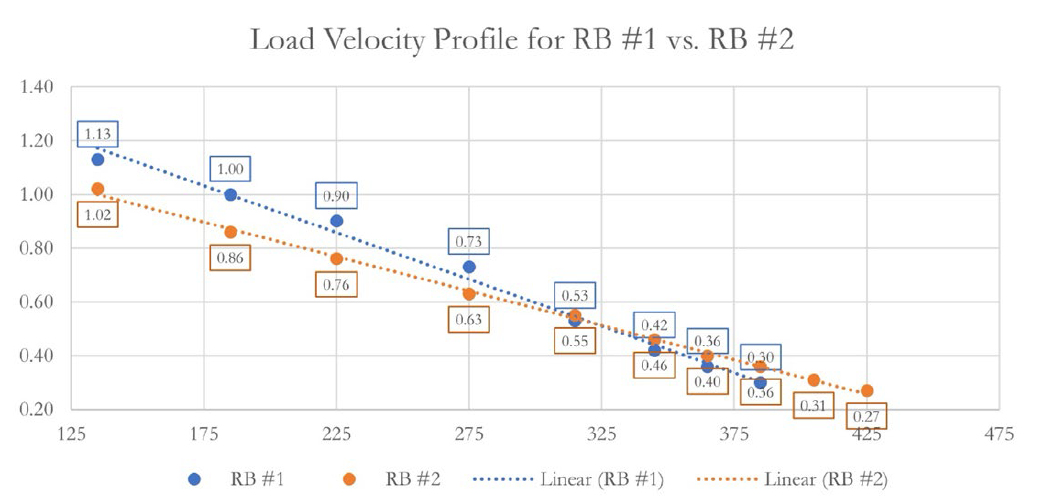
FIGURE 1. DIFFERENCES AND SIMILARITIES IN LOAD-VELOCITY PROFILES FOR ATHLETES THAT PLAY THE SAME POSITION, FINDINGS FROM AN INTERNAL CASE STUDY
This article originally appeared in NSCA Coach, a quarterly publication for NSCA Members that provides valuable takeaways for every level of strength and conditioning coach. You can find scientifically based articles specific to a wide variety of your athletes’ needs with Nutrition, Programming, and Youth columns. Read more articles from NSCA Coach »
Related Reading
REFERENCES
1. Bryce, AR, Mann, BJ, Eserhaut, DA, Hermes, MJ, Nicoll, JX, and Fry, AC. Autoregulatory progressive resistance exercise: Linear versus a velocity-based flexible model. Gazzetta Medica Italiana Archivio per le Scienze Mediche 183(10): 791-802, 2024.
2. Cabarkapa, DV, Fry, AC, Kavadas, NG, and Cabarkapa, D. Are load-velocity estimates of bench press maximal strength as accurate as actual 1-repetition maximum testing? Journal of Strength and Conditioning Research 38(10): e563-e573, 2024.
3. Flanagan, EP, and Jovanovic, M. Researched applications of velocity-based strength training. Journal of Australian Strength and Conditioning, 21(1): 58-69, 2014.
4. Fleck, SJ, and Kraemer, W. Designing Resistance Training Programs, 4th ed. Champaign IL: Human Kinetics; 2014.
5. González-Badillo, JJ, and Sánchez-Medina, L. Movement velocity as a measure of loading intensity in resistance training. International Journal of Sports Medicine 31(05): 347-352, 2010.
6. Hernández-Belmonte, A, and Pallarés, JG. Effects of velocity loss threshold during resistance training on strength and athletic adaptations: A systematic review with meta-analysis. Applied Sciences 12(9): 4425, 2022.
7. Mann, B. Developing Explosive Athletes: Use of Velocity Based Training In Athletes. Ultimate Athlete Concepts; 2021.
8. Mann, JB, Ivey, PA, and Sayers, SP. Velocity-based training in football. Strength and Conditioning Journal 37(6): 52-57, 2015.
9. Mann, JB, Thyfault, JP, Ivey, PA, and Sayers, SP. The effect of autoregulatory progressive resistance exercise vs. linear periodization on strength improvement in college athletes. Journal of Strength and Conditioning Research 24(7): 1718-1723, 2010.
10. Pareja-Blanco, F, Rodríguez-Rosell, D, Sánchez-Medina, L, Sanchis-Moysi, J, Dorado, C, Mora-Custodio, R, et al. Effects of velocity loss during resistance training on athletic performance, strength gains and muscle adaptations. Scandinavian Journal of Medicine and Science in Sports 27(7): 724-735, 2016.
11. Randell, AD, Cronin, JB, Keogh, JW, Gill, ND, and Pedersen, MC. Effect of instantaneous performance feedback during 6 weeks of velocity-based resistance training on sport-specific performance tests. Journal of Strength and Conditioning Research 25(1): 87-93, 2011.
12. Richens, B, and Cleather, D. The relationship between the number of repetitions performed at given intensities is different in endurance and strength trained athletes. Biology of Sport 31(2): 157-161, 2014.
13. Shattock, K, and Tee, JC. Autoregulation in resistance training: A comparison of subjective versus objective methods. Journal of Strength and Conditioning Research 36(3): 641-648, 2020.
14. Stone, MH, and O’Bryant, HS. Weight Training: A Scientific Approach. Burgess Publishing Company; 1987.
15. Weakley, JJS, Wilson, KM, Till, K, Read, DB, Darrall-Jones, J, Roe, GAB, Phibbs, PJ, and Jones, B. Visual feedback attenuates mean concentric barbell velocity loss and improves motivation, competitiveness, and perceived workload in male adolescent athletes. Journal of Strength and Conditioning Research 33(9): 2420-2425, 2019.
16. Weakley, J, Mann, B, Banyard, H, McLaren, S, Scott, T, and Garcia-Ramos, A. Velocity-based training: From theory to application. Strength and Conditioning Journal 43(2): 31-49, 2020.
17. Włodarczyk, M, Adamus, P, Zieliński, J, and Kantanista, A. Effects of velocity-based training on strength and power in elite athletes—A systematic review. International Journal of Environmental Research and Public Health 18(10): 5257, 2021.
18. Zatsiorsky, VM, Kraemer, WJ, and Fry, AC. Science and Practice of Strength Training. Champaign, IL: Human Kinetics; 2021.
Learn about the benefits of NSCA Membership »
About the author
Andrew Corliss Fry, PhD, CSCS,*D, FNSCA*E
andrew.fry.980
andrew-fry-a3a21137a
Contact Andrew Fry
Contact Andrew Fry
Your first name is required.
Your last name is required.
Your email is required.
Your message is required.
Your reCaptcha is required.
Your email was successfully sent to Andrew Fry
Andrew Fry is a Professor of Exercise Physiology at the University of Kansas, where he is also the director for the graduate program in exercise physi ...
View full biography
Audience:
Coaches
Coaches
Topics:
Exercise Science Exercise Technique Program design Organization and Administration Testing and Evaluation Client Consultation|Assessment Safety Basic Pathophysiology and Science of Health Status or Condition and Disorder or Disease Professional Development
Exercise Science Exercise Technique Program design Organization and Administration Testing and Evaluation Client Consultation|Assessment Safety Basic Pathophysiology and Science of Health Status or Condition and Disorder or Disease Professional Development
Keywords:
Training Adaptations Strength Programming Load Training Velocity Sport Performance Training Volume Power Development Football Training
Training Adaptations Strength Programming Load Training Velocity Sport Performance Training Volume Power Development Football Training

- Privacy Policy
- Your Privacy Choices

- Terms of Use
- Retraction and Correction Policy
- © 2026 National Strength and Conditioning Association