

Training Considerations for the Female Firefighter – Bridging the Evidence Gap in Tactical Strength and Conditioning
by Annmarie Chizewski, PhD, CSCS, USAW, Joel Martin, PhD, CSCS,*D, CPSS, Lee Brown, PhD, CSCS, CSPS, TSAC-F, RSCC, Steve Ferrier, and Mick Jackson
TSAC Report
May 2026
Vol 81, Issue 1
This TSAC Report article discusses an evidence-based approach to why female firefighters need sex-specific training to improve readiness, reduce injury risk, and support long-term career sustainability.
INTRODUCTION
A structure fire does not discriminate. Whether it is a 180-lb male firefighter or a 140-lb female firefighter entering that building, the victim weighs the same, the hose weighs the same, and the ceiling falls with equal force. The job demands are universal, yet the research informing how we prepare firefighters for these demands is not. Firefighting imposes a unique blend of aerobic, anaerobic, and musculoskeletal demands, amplified by extreme heat exposure, heavy load carriage, and unpredictable shift work (4). While these challenges affect all firefighters, the training strategies and injury prevention protocols used across the fire service have been developed almost exclusively from research on male populations, but with the growing number of females entering the fire service, research needs to expand beyond traditional male cohorts (23). This is not just a research limitation, it is a readiness and safety issue affecting the growing number of women entering the fire service, who now comprise approximately 9% of firefighters in both the United States and United Kingdom (5,11).
As female representation continues to increase, tactical strength and conditioning (TSAC) professionals can no longer rely on a one-size-fits-all approach. Female firefighters possess distinct physiological characteristics that interact with tactical demands in ways that affect strength development, recovery, and injury risk (9,10,21). While fireground injury rates appear comparable between male and female firefighters (approximately 61 per 1,000), emerging evidence suggests that injury mechanisms and anatomical sites may differ, particularly in relation to equipment fit and neuromuscular control patterns (20). Biomechanical analyses suggest that female firefighters often adopt adaptive movement strategies during identical occupational tasks, modifying traditional male-dominant techniques to accommodate anthropometric and strength differences, adaptations that may influence observed sex-specific injury patterns. Additionally, female firefighters experience nearly four times the rate of ill-fitting personal protective equipment (PPE) compared to males (79.7% vs. 20.9%), which may alter movement mechanics and increase injury risk (12,13). These findings underscore the need for sex-specific training approaches that optimize movement efficiency and address biomechanical risk factors unique to female firefighters.
THE RESEARCH LANDSCAPE: THE EXTRAPOLATION PROBLEM
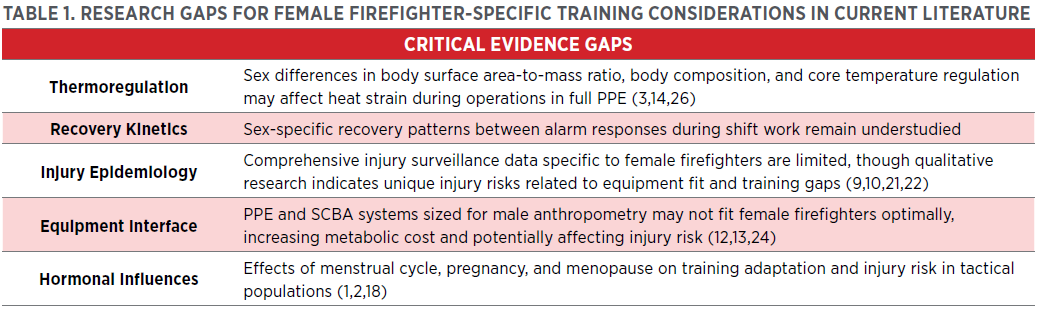
Firefighter performance standards, such as the Candidate Physical Ability Test (CPAT), are appropriately job-specific and sex-neutral designed in line with the U.S. Equal Employment Opportunity Commission (EEOC). However, research underpinning how to train firefighters, prevent injuries, and optimize recovery has been conducted predominantly in male cohorts (19,23). This creates the extrapolation problem: assuming that training principles derived from male firefighters will produce equivalent results in females. There are several critical research areas needed to support female firefighters (Table 1).
READINESS AND OPERATIONAL EFFECTIVENESS
Understanding physiological factors influencing female firefighter performance allows TSAC professionals to design programs that efficiently build required strength, power, and work capacity. Research demonstrates strong relationships between physical fitness, including cardiovascular endurance, muscular strength, anaerobic capacity, and occupational task performance (19,23). Failing to account for sex-specific physiology risks either under-preparing female firefighters (e.g., safety liability) or overtaxing recovery capacity (e.g., increased injury risk, reduced career longevity).
INJURY PREVENTION
Data from athletic populations indicates females demonstrate higher anterior cruciate ligament (ACL) injury rates (up to eight times higher in some sports) related to neuromuscular control differences, joint laxity, and biomechanical factors such as knee valgus during dynamic movements (20,21). Prospective studies demonstrate that increased knee valgus angles during landing predict future ACL injury in female athletes (8,15). While firefighting may not involve the cutting and pivoting movements typical of sport, fireground operations regularly require jumping down from apparatus, rapid changes in direction while carrying equipment, climbing and descending ladders under load, and navigating unstable surfaces—all tasks involving dynamic landing and deceleration mechanics (25). Additionally, ill-fitting PPE affecting nearly 80% of female firefighters may further compromise movement mechanics and increase biomechanical injury risk (12,13). Understanding these neuromuscular control patterns enables proactive programming incorporating movement screening, landing mechanics training, and strategies to address the combined challenges of occupational demands and equipment fit issues unique to female firefighters.
ENTRY, RETENTION, AND CAREER SUSTAINABILITY
Recruiting and retaining female firefighters requires evidence-based physical preparation strategies. While occupational performance standards such as the CPAT are appropriately sex-neutral and job-based, female recruits may benefit from tailored training programs that efficiently prepare them to meet these universal requirements. Once hired, lack of sex-specific support during key career phases, particularly pregnancy, postpartum, and menopause, contributes to unnecessary attrition. Evidence-informed training support systems across the career span can improve both recruitment success and retention of experienced female firefighters.
PHYSIOLOGICAL CONSIDERATIONS IMPACTING TRAINING
Understanding the physiological characteristics that distinguish male and female firefighters is essential for TSAC professionals designing training programs that optimize performance while minimizing injury risk. These differences are not deficits to overcome, but rather physiological realities that inform intelligent programming. While female firefighters must meet the same operational standards as their male counterparts, sex-specific differences in anthropometry, neuromuscular function, cardiovascular physiology, connective tissue properties, and hormonal profiles influence how training loads are tolerated, how quickly adaptations occur, and how recovery is managed. The following sections outline key physiological considerations and their practical implications for program design.
ANTHROPOMETRIC AND NEUROMUSCULAR DIFFERENCES
Female firefighters typically present with lower absolute body mass and lean muscle mass, resulting in greater relative loading when carrying standardized equipment. Research comparing male and female firefighters has documented these anthropometric differences and their implications for operational performance (21). However, when cardiovascular fitness is expressed relative to body weight (ml/kg/min), female firefighters may demonstrate similar or even superior values compared to males. This creates a potential paradox for fitness assessment: while relative VO₂max values may appear adequate, the absolute work output required for firefighting tasks, such as advancing hose lines, raising ladders, and carrying victims, remains constant regardless of body mass (25). Therefore, fitness standards based solely on relative measures (ml/kg/min) may not fully capture the absolute strength and work capacity demands of fireground operations. This underscores the importance of occupational performance testing (e.g., CPAT) that directly assess task completion rather than relying exclusively on normalized physiological metrics. Female firefighters may require training programs that emphasize absolute strength development and work capacity in addition to improving relative fitness measures, ensuring they can generate sufficient force and power to meet the fixed demands of firefighting tasks.
PROGRAMMING IMPLICATIONS
While females generally demonstrate lower absolute aerobic capacity and lean muscle mass compared to males, research demonstrates that when cardiovascular fitness is expressed relative to body weight, female firefighters may achieve similar or even superior values (21). As discussed above, absolute work capacity remains critical for operational tasks. Programming should therefore focus on maximizing both relative and absolute physical capacities.
-
- Prioritize relative strength development (strength-to-body-mass ratios) while simultaneously building absolute strength capacity.
- Evaluate strength relative to total system mass (body mass and PPE load), recognizing that female firefighters carry proportionally greater loads.
- Incorporate loaded movement training replicating equipment carriage patterns (e.g., hose drags, ladder carries, victim rescue simulations).
- Emphasize postural strength and trunk stability for managing anterior self-contained breathing apparatus (SCBA) loading.
- Implement heavy resistance training (greater than 80% of one-repetition maximum [1RM]) to maximize neural adaptations and absolute force production.
- Include power development (e.g., Olympic-style lift variations, plyometrics, medicine ball throws) to enhance rate of force development.
- Develop grip strength and forearm endurance (e.g., farmer’s carries, dead hangs, and thick bar work).
CARDIOVASCULAR AND WORK CAPACITY
Firefighting requires substantial cardiovascular fitness. Research demonstrates that aerobic capacity is significantly correlated with firefighting task performance, with anaerobic and cardiovascular fitness being the best predictors of CPAT performance (6,23). Programming should develop both aerobic capacity through high-intensity interval training and sustained moderate-intensity work, as well as work capacity training that mimics the intermittent, high-intensity nature of fireground operations.
CONNECTIVE TISSUE AND JOINT CHARACTERISTICS
Females typically present with greater general joint laxity, which may be further influenced by hormonal fluctuations across the menstrual cycle (8). Additionally, anatomical factors including greater Q-angle (the angle between the quadriceps and patellar tendon) are associated with increased mechanical disadvantage at the knee joint, potentially contributing to higher ACL injury rates observed in female athletes (17). While firefighting differs from athletic movements, these biomechanical and connective tissue characteristics remain relevant given the dynamic loaded tasks firefighters perform, including jumping from apparatus, rapid directional changes with equipment, and ladder climbing under load.
PROGRAMMING IMPLICATIONS
-
- Emphasize joint stability training alongside mobility work. Not all firefighters need more mobility, but some require more stability.
- Include deceleration and landing mechanics training to reduce ACL injury risk, with particular attention to controlling knee valgus and maintaining proper alignment.
- Address Q-angle mechanical disadvantage through hip and glute strengthening to improve knee control during dynamic tasks.
- Implement movement screening to identify hypermobility or instability patterns requiring specific intervention.
HORMONAL INFLUENCES: THE MENSTRUAL CYCLE
Female firefighters experience monthly hormonal fluctuations that may influence training responses and recovery. While research shows considerable individual variability, several key findings emerge (1,2,18):
-
- Perceived performance: 50 – 71% of female athletes report feeling their performance is impaired during certain menstrual cycle phases, most commonly early follicular (menstruation) and late luteal phases (1).
- Objective performance: Studies examining objective performance measures show inconsistent effects, suggesting high individual variability through menstrual phases (18).
- Physiological considerations: Female sex hormones influence fluid regulation, cardiovascular function, thermoregulation, and metabolic responses (2).
PRACTICAL APPLICATION
-
- Educate female firefighters about potential cycle influences and encourage self-monitoring.
- Normalize conversation about menstrual health.
- Individualize programming based on each firefighter’s experience rather than rigid cycle-based periodization.
- Remain flexible to accommodate symptom-affected training days.
- Consider higher-volume or higher-intensity work during follicular phase (days 1 – 14) if the firefighter reports better tolerance.
EVIDENCE-BASED PROGRAMMING FRAMEWORK: ASSESSMENT PRIORITIES
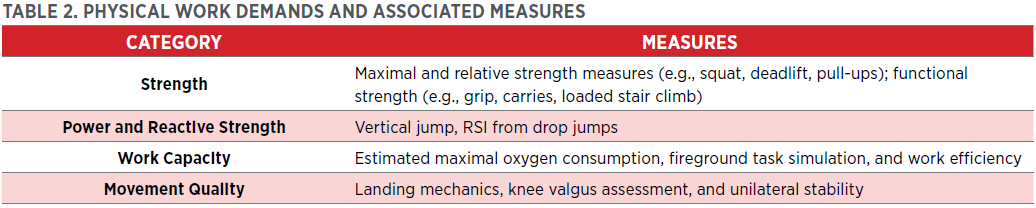
Baseline and ongoing assessments should evaluate key physical capacities required for firefighting while identifying individual strengths, limitations, and injury risk factors (Table 2).
RESISTANCE TRAINING
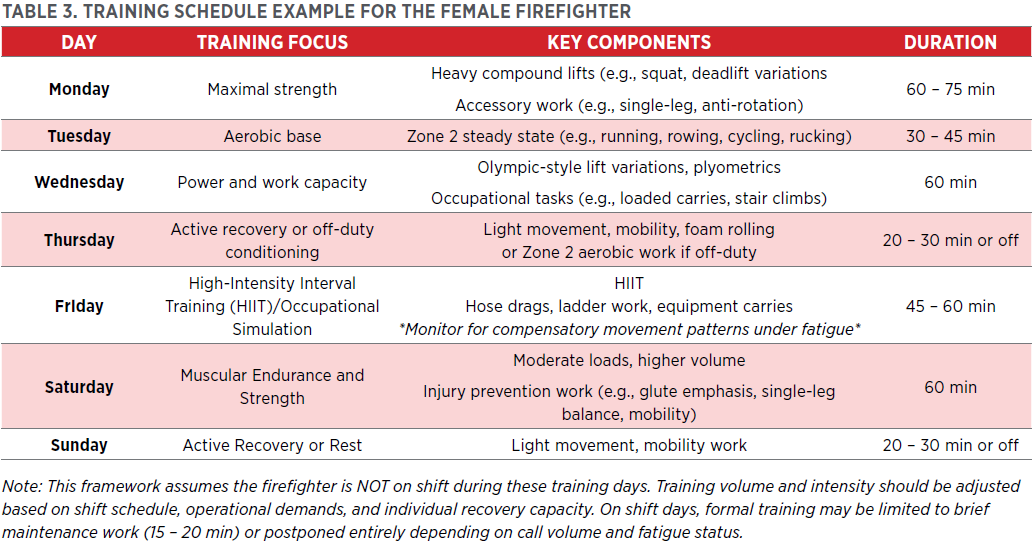
Strength training forms the foundation of firefighter physical preparation. Key programming principles include (Table 3):
-
- Working up to heavy compound movements, such as squat, deadlift, press, and pull variations.
- Train strength-power continuum (e.g., greater than 85% 1RM for strength, 30 – 60% 1RM performed explosively for power).
- Emphasize relative strength tracking.
- Include unilateral training for asymmetries (e.g., single-leg squats, split squats, single-arm carries).
- Incorporate trunk stability under load (e.g., loaded carries, anti-rotation exercises).
PRACTICAL CONSIDERATIONS FOR SHIFT WORK INTEGRATION
The sample training framework presented in Table 3 represents an ideal week for a firefighter during off-duty days. However, TSAC professionals must account for the unpredictable nature of shift work when designing programs for firefighters.
SHIFT SCHEDULE MODIFICATIONS:
-
- 24-hr shifts: Training should occur on off-duty days. On-shift training, if conducted, should be brief (15 – 20 min), low-to-moderate intensity, and focused on movement quality or mobility rather than high-load or fatiguing work.
- 48/96 schedules (48 hr on, 96 hr off): The four-day off-duty window allows for the complete training cycle. Avoid heavy training immediately before returning to shift.
- High call-volume shifts: Skip or significantly reduce planned training the day following a busy shift to allow for adequate recovery.
FORM AND TECHNIQUE PRECAUTIONS
Given the increased injury risk associated with poor movement mechanics—particularly knee valgus in female firefighters—the following technical standards should be emphasized:
-
- Landing mechanics: All plyometric and jump training should emphasize soft landings with knees tracking over toes (avoiding inward collapse). Video analysis during drop jumps or box step-downs can identify compensatory patterns.
- Squatting and deadlifting: Maintain neutral spine, control descent speed (2 – 3 s for eccentric phase), and ensure knees track in line with toes throughout the movement. Single-leg variations should be performed with a stable pelvis and no lateral trunk lean.
- Loaded carries: Maintain upright posture, avoid excessive forward lean, and ensure symmetrical loading when possible. Asymmetrical carries (e.g., suitcase carries, single-arm overhead) should be performed with active anti-rotation trunk engagement.
- Fatigue monitoring: Technique should never be sacrificed for volume or load. If movement quality degrades, reduce load or terminate the set.
INJURY RISK MANAGEMENT
-
- Progressive loading: Increase training load by no more than 5 – 10% per week, particularly for lower extremity exercises.
- Deload weeks: Every 4th week should include a 40 – 50% reduction in training volume to allow for tissue adaptation and recovery.
- Movement screening: Conduct quarterly movement assessments (e.g., landing mechanics, single-leg squat, overhead squat) to identify developing compensatory patterns or asymmetries.
- Knee stress monitoring: Female firefighters with history of knee pain or diagnosed patellar tracking issues should receive modified programming with emphasis on posterior chain strengthening and controlled eccentric loading.
- Autoregulation: Use rating of perceived exertion (RPE) or readiness scales to adjust daily training intensity based on fatigue from shift work.
RECOVERY PRIORITIZATION
Sleep deprivation, circadian disruption, and cumulative fatigue from shift work significantly impair recovery capacity. Training programs must be flexible enough to accommodate these realities:
-
- If sleep was significantly disrupted on shift (< 4 hr), consider postponing high-intensity or heavy strength sessions.
- Post-shift days may be better suited for low-intensity aerobic work or mobility rather than maximal efforts.
- Nutrition and hydration status post-shift should be optimized before returning to training.
This approach ensures that training enhances—rather than compromises—operational readiness and long-term health.
MONITORING NEUROMUSCULAR FUNCTION: REACTIVE STRENGTH INDEX
The reactive strength index (RSI) combined with video analysis provides practical monitoring especially valuable given higher ACL injury incidence in females. RSI measures an individual’s ability to rapidly change from eccentric to concentric muscle action, a critical component of reactive strength (7). RSI equals jump height (in meters) divided by ground contact time (in seconds). RSI has demonstrated excellent test-retest reliability (intraclass correlation coefficient greater than 0.90, coefficient of variation 6 – 8%) and is significantly correlated with sprint performance, change of direction ability, and overall athletic performance (7). RSI can be assessed using force plates or validated jump mat systems. While force plates are considered the gold standard for measuring ground reaction forces and contact time, validated jump mat systems have demonstrated acceptable reliability for field-based reactive strength assessment when standardized protocols are used, with significantly greater accessibility for fire departments and tactical training environments (7). Jump mats are cost-effective, portable, plug-and-play systems that require minimal setup time, no advanced technical expertise, and often no ongoing software subscription fees such as the Chronojump® system. For most applied TSAC settings, validated jump mats provide sufficient accuracy to guide programming decisions while improving feasibility and long-term compliance.
TESTING PROTOCOL
-
- Using force plates or a validated and reliable jump mat.
- Drop jump from a 30-cm box (standardized height).
- Instruct to minimize ground contact time while maximizing jump height.
- 3 – 5 trials; use best or average of top three scores.
- Test monthly during return-to-duty or quarterly for ongoing monitoring.
VIDEO ANALYSIS FOR INJURY RISK
Quantitative RSI data should be complemented by video analysis to identify movement patterns associated with ACL injury risk. Prospective research demonstrates that knee valgus angles during landing are significant predictors of future ACL injury in female athletes (16,17).
Key markers:
-
- Knee valgus: Medial knee collapse during landing (flag greater than 10-degree deviation from neutral).
- Asymmetrical loading: Unequal weight distribution between legs.
- Stiff landings: Minimal knee or hip flexion upon landing.
- Trunk position: Excessive forward or lateral lean.
CORRECTIVE STRATEGIES
-
- For low RSI: Eccentric strength training (e.g., tempo squats, Nordic curls), reactive progressions, and ankle stiffness drills.
- For knee valgus: Glute medius strengthening, verbal and visual cueing, and movement pattern practice with feedback.
- For asymmetries: Unilateral strength work, proprioceptive training, and address underlying mobility limitations.
TSAC professionals should collaborate with medical specialists when corrective programming is insufficient. Referral to a pelvic health physical therapist, sports physical therapist, or orthopedic specialist is warranted when movement dysfunction persists despite intervention or when pain is reported during training or operational tasks.
RECOVERY STRATEGIES
Shift work, thermal strain, and unpredictable demands impair recovery for all firefighters. However, female firefighters may experience additional recovery challenges related to hormonal fluctuations across the menstrual cycle, with some women reporting reduced recovery capacity during the late luteal phase (1). Evidence-based recovery strategies should be individualized based on operational demands, shift schedules, and individual response.
SLEEP OPTIMIZATION:
-
- Post-shift protocols: Dark, cool sleeping environment; blackout curtains; sleep hygiene routines.
- Strategic napping: 20 – 30-min power naps or 90-min full-cycle naps during shifts when operationally feasible.
- Sleep tracking: Encourage the use of wearable technology or sleep diaries to identify patterns and cumulative sleep debt.
NUTRITION FOR RECOVERY AND ADAPTATION
PROTEIN
-
- Target: 1.6 – 2.0 g/kg body weight daily, distributed across 4 – 5 meals.
- Rationale: Supports muscle protein synthesis, tissue repair, and maintenance of lean mass during shift work stress.
- Distribution: 25 – 30 g per meal optimizes muscle protein synthesis.
- Practical challenge: Shift work and unpredictable call volume make consistent meal timing difficult; pre-prepared high-protein snacks and shelf-stable options (e.g., protein powder, jerky, Greek yogurt, hard-boiled eggs) can help meet targets.
CARBOHYDRATES
-
- Target: 3 – 5 g/kg body weight daily depending on training volume and operational demands.
- Rationale: Supports glycogen replenishment for repeated high-intensity efforts during multi-alarm responses.
- Timing: Prioritize carbohydrate intake post-shift and post-training to optimize recovery.
HYDRATION
-
- Assessment: Monitor urine color throughout the shift (pale yellow indicates adequate hydration, dark yellow/amber indicates dehydration).
- Body weight monitoring: Weigh pre- and post-shift (1 kg loss = ~1 liter fluid deficit).
- Rehydration strategy: Replace 150% of fluid losses within 4 – 6 hr post-shift (e.g., 1.5 liters for every 1 kg lost).
- During operations: Encourage regular fluid intake before, during, and after fire suppression activities. Sweat losses are elevated under PPE and thirst cues may be blunted.
- Electrolyte considerations: For prolonged operations (more than two hours) or significant sweat losses, include electrolyte-containing beverages to replace sodium and potassium losses.
POST-SHIFT/POST-TRAINING NUTRITION
“Go bag” strategy: Pre-pack shelf-stable, nutrient-dense foods to consume immediately post-operation when kitchen access or meal preparation is impractical.
Contents: Protein powder/ready-to-drink shakes, mixed nuts, dried fruit, whole grain crackers, nut butter packets, and electrolyte drink mix.
Rationale: Supports immediate recovery needs and prevents reliance on convenience foods that may be calorie-dense but nutrient-poor.
ARE THESE RECOMMENDATIONS DIFFERENT FOR MEN?
The protein recommendations (1.6 – 2.0 g/kg) and hydration strategies apply to both male and female firefighters. However, the rationale for emphasizing these targets may differ (1,2,4):
-
- Females and protein: Given lower absolute lean muscle mass, maintaining adequate protein intake is critical for preserving muscle mass during periods of high operational stress or when training may be inconsistent due to shift work.
- Females and hydration: Some evidence suggests females may have different fluid regulation responses and may be at higher risk for hyponatremia (low blood sodium) when over-hydrating with plain water during prolonged exercise; this underscores the importance of electrolyte inclusion during extended operations.
- Menstrual cycle considerations: Some females report increased hunger and carbohydrate cravings during the luteal phase; understanding this as a normal physiological response rather than “poor willpower” can support better nutrition adherence.
POTENTIAL ALTERNATIVE RECOVERY MODALITIES
-
- Photobiomodulation (red/near-infrared light therapy): May enhance mitochondrial function, reduce inflammation, and improve sleep quality in shift workers.
- Compression garments: May enhance recovery between training sessions or operational shifts by improving venous return.
- Contrast therapy or cold water immersion: May reduce muscle soreness; timing relative to training goals should be considered (avoid immediately post-strength training if hypertrophy is the goal).
ACTIVE RECOVERY
-
- Low-intensity movement on off-days (e.g., walking, cycling, swimming, yoga).
- Promotes blood flow and psychological recovery without adding training stress.
STRESS MANAGEMENT AND MENTAL RECOVERY
-
- Mindfulness and breathing practices.
- Peer support and mentorship programs.
- Access to mental health resources.
CREATING AN INCLUSIVE TRAINING CULTURE
Beyond programming, TSAC professionals must address organizational culture:
-
- Normalize physiology conversations: Menstrual health, pregnancy, and menopause should not be taboo topics.
- Individualize within standards: Universal performance requirements with individualized pathways.
- Advocate for equipment fit: Properly sized PPE is a safety issue, not a comfort preference.
- Support mentorship: Connect female firefighters navigating similar career transitions.
- Engage leadership: Emphasize policy support, research investment, visible organizational commitment.
CONCLUSION AND FUTURE DIRECTIONS
Operational standards must remain job-specific and sex-neutral, as the work demands do not change. However, maintaining universal standards does not require universal programming. Female firefighters face the same demands, but may require different training strategies to optimally meet them. Operational standards remain universal, but intelligent programming recognizes individual physiology. TSAC professionals should incorporate sex-specific considerations alongside other individualization factors, such as training age, injury history, and shift schedules, to optimize readiness and reduce injury risk across all firefighters.
RESEARCH PRIORITIES
Female-specific normative data for strength, power, and work capacity are meant to inform training design and progression strategies. Current benchmarks are predominantly derived from male populations. Female-specific reference data would enable TSAC professionals to set appropriate training loads, monitor adaptation, and identify athletes who may benefit from additional support, without creating punitive fitness standards or employment barriers.
Comprehensive injury epidemiology and sex-specific risk factors should be examined across the firefighter career span. While injury rates appear similar between sexes, injury mechanisms, anatomical sites, and contributing factors (e.g., equipment fit, biomechanical patterns, training exposures) may differ. Understanding these differences would enable targeted injury prevention interventions and inform equipment design standards, reducing lost duty days and improving career longevity for all firefighters. One example of these differences is thermoregulation and heat stress responses in full PPE during operational and training tasks. Sex differences in body surface area-to-mass ratio, sweat rate, and core temperature regulation may affect heat strain during fireground operations. Research examining these responses in female firefighters wearing properly fitted PPE would inform work-rest cycles, hydration protocols, and heat stress monitoring strategies, enhancing safety during extended operations in extreme environments.
Additionally, hormonal influences on training adaptation, recovery capacity, and injury risk across the menstrual cycle and reproductive lifespan should be examined. While individual variability is high, understanding how estrogen and progesterone fluctuations affect muscle protein synthesis, connective tissue laxity, substrate utilization, and fatigue resistance would enable TSAC professionals to optimize training periodization and recovery strategies. This research should extend beyond the menstrual cycle to include pregnancy, postpartum, and perimenopausal phases, supporting performance maintenance across career-critical life stages.
TSAC professionals can contribute through research collaboration, data collection with informed consent, case documentation, and advocacy for research funding. The evidence gap is real but closing, and practitioners must apply current best practices while contributing to the research base informing future programming.
This article originally appeared in TSAC Report, the NSCA’s quarterly, online-only publication geared toward the training of tactical athletes, operators, and facilitators. It provides research-based articles, performance drills, and conditioning techniques for operational, tactical athletes. The TSAC Report is only available for NSCA Members. Read more articles from TSAC Report
Related Reading
REFERENCES
1. Carmichael, MA, Thomson, RL, Moran, LJ, and Wycherley, TP. The impact of menstrual cycle phase on athletes’ performance: A narrative review. International Journal of Environmental Research and Public Health 18(4): 1667, 2021.
2. Constantini, NW. The menstrual cycle and sport performance. Clinical Sports Medicine 24(2): 51-82, 2005.
3. Dervis, S, Coombs, GB, Chaseling, GK, Filingeri, D, Smoljanic, J, and Jay, O. A comparison of thermoregulatory responses to exercise between mass-matched groups with large differences in body fat. Journal of Applied Physiology 120(6): 2016.
4. Dos Santos, ML, Lockie, RG, Orr, R, Dinyer-McNeely, T, Smith, D, McDonald, S, and Dawes, J. The metabolic demand of firefighting: A systematic review. Physiologia 5(2): 12, 2025.
5. Fahy, R, Evarts, B, and Stein, G. U.S. fire department profile. National Fire Protection Association. 2023. Retrieved 2025 from https://www.nfpa.org/education-and-research/research/nfpa-research/fire-statistical-reports/us-fire-department-profile.
6. Findley, BW, Brown, LE, and Whitehurst, M. Anaerobic power performance of incumbent female firefighters. Journal of Strength and Conditioning Research 16(3): 474-476, 2002.
7. Flanagan, EP, Ebben, WP, and Jensen, RL. Reliability of the reactive strength index and time to stabilization during depth jumps. Journal of Strength and Conditioning Research 22(5): 1677-1682, 2008.
8. Hewett, TE, Myer, GD, Ford, KR, Heidt, RS, Colosimo, AJ, McLean, SG, et al. Biomechanical measures of neuromuscular control and valgus loading of the knee predict anterior cruciate ligament injury risk in female athletes: A prospective study. American Journal of Sports Medicine 33(4): 2005.
9. Hollerbach, BS, Heinrich, KM, and Poston, WSC. Female firefighters and occupational injury: A qualitative study of injury experiences. Women’s Health Reports 1(1): 2019.
10. Hollerbach, BS, Kaipust, CM, Poston, WSC, Haddock, CK, Heinrich, KM, and Jahnke, SA. Injury correlates among a national sample of women in the US fire service. Journal of Occupational and Environmental Medicine 62(8): 2020.
11. Home Office. Fire and rescue workforce and pensions statistics: England, year ending March 2023. UK Government. Retrieved 2025 from https://www.gov.uk/government/statistics/fire-workforce-and-pension-statistics-year-ending-march-2023/fire-and-rescue-workforce-and-pensions-statistics-england-year-ending-march-2023.
12. Hsiao, H, Whitestone, J, Kau, TY, Whisler, R, Routley, JG, and Wilbur, M. Sizing firefighters: Method and implications. Human Factors 56(5): 2014.
13. Hulett, DM, Bendick, M, Thomas, SY, and Moccio, F. A national report card on women in firefighting. International Association of Women in Fire and Emergency Services. 2008. Retrieved 2025 from https://policygroupontradeswomen.org/wp-content/uploads/2020/12/NationalReportCardonWomeninFirefighting.pdf.
14. Kaciuba-Uscilko, H, and Grucza, R. Gender differences in thermoregulation. Current Opinion in Clinical Nutrition and Metabolic Care 4(6): 2001.
15. Koga, H, Nakamae, A, Shima, Y, Bahr, R, and Krosshaug, T. Hip and ankle kinematics in noncontact anterior cruciate ligament injury situations: Video analysis using model-based image matching. American Journal of Sports Medicine 46(2): 2018.
16. Larwa, J, Stoy, C, Chafetz, RS, Boniello, M, and Franklin, C. Stiff landings, core stability, and dynamic knee valgus: A systematic review on documented anterior cruciate ligament ruptures in male and female athletes. International Journal of Environmental Research and Public Health 18(7): 3826, 2021.
17. Mancino, F, Kayani, B, Gabr, A, Fontalis, A, Plastow, R, and Haddad, FS. Anterior cruciate ligament injuries in female athletes: Risk factors and strategies for prevention. Bone and Joint Open 5(2): 2024.
18. McNulty, KL, Elliott-Sale, KJ, Dolan, E, Swinton, PA, Ansdell, P, et al. The effects of menstrual cycle phase on exercise performance in eumenorrheic women: A systematic review and meta-analysis. Sports Medicine 50(10): 1813-1827, 2020.
19. Naylor, JM, Sothmann, MS, and McAllister, MJ. Validity and relevance of the pack hike wildland firefighter work capacity test: A review. Journal of Exercise and Physiology Online 13(4): 2010.
20. Pawer, S, Turcotte, K, Desapriya, E, Zheng, A, Purewal, A, Wellar, A, et al. Female firefighter work-related injuries in the United States and Canada: An overview of survey responses. Frontiers in Public Health 10: 2022.
21. Perroni, F, Cardinali, L, Cignitti, L, Gobbi, E, Grugni, F, Amatori, S, et al. Are there sex differences in physiological parameters and reaction time responses to overload in firefighters? PLoS One 16(5): 2021.
22. Sell, K, Abel, M, Dawes, JJ, Thompson, M, Zapp, A, Pottorf, O, et al. Improper fitting personal protective clothing and subsequent countermeasures for physical conditioning in female firefighters: A narrative review. International Journal of Physical Activity and Health 4(2): 2025.
23. Smith, DL, Petruzzello, SJ, Kramer, JF, Youngstedt, SD, and Pandolf, KB. Physiological demands of the firefighter Candidate Physical Ability Test. Journal of Strength and Conditioning Research 23(1): 653-662, 2009.
24. Sokolowski, SL. Examination of current U.S. female firefighting personal protective equipment: Fit, design and functional implications. Fashion and Textiles 9(24): 2022.
25. Williams-Bell, FM, Villar, R, Sharratt, MT, and Hughson, RL. Physiological demands of the firefighter Candidate Physical Ability Test. Medicine and Science in Sports and Exercise 41(3): 653-662, 2009.
26. Yanovich, R, Ketko, I, and Charkoudian, N. Sex differences in human thermoregulation: Relevance for 2020 and beyond. Physiology 35(3): 2020
Learn about the benefits of NSCA Membership »
About the author
Lee Brown, PhD, CSPS,*D, CSCS,*D, TSAC-F,*D, RSCC
Contact Lee Brown
Your first name is required.
Your last name is required.
Your email is required.
Your message is required.
Your reCaptcha is required.
Your email was successfully sent to Lee Brown
Lee Brown is currently working towards a PhD by publication of Practical Application of Strength and Conditioning Preparation for Muay Thai Coaches an ...
View full biography
Audience:
TSAC Facilitators
TSAC Facilitators
Topics:
Exercise Science Exercise Technique Program design Organization and Administration Testing and Evaluation Safety Basic Pathophysiology and Science of Health Status or Condition and Disorder or Disease Professional Development
Exercise Science Exercise Technique Program design Organization and Administration Testing and Evaluation Safety Basic Pathophysiology and Science of Health Status or Condition and Disorder or Disease Professional Development
Keywords:
Injury Prevention Career Sustainability Female Firefighters Sex specific Training First Responder Readiness Strength Training Occupational Fitness Candidate Physical Ability Test (CPAT)
Injury Prevention Career Sustainability Female Firefighters Sex specific Training First Responder Readiness Strength Training Occupational Fitness Candidate Physical Ability Test (CPAT)

- Privacy Policy
- Your Privacy Choices

- Terms of Use
- Retraction and Correction Policy
- © 2026 National Strength and Conditioning Association