

Meredith Butulis on Movement, Curiosity, and Comebacks
by NSCA
Other
July 2026
After failing gym class twice, she became a world-level fitness athlete and built a career helping others move past old limits.
The Coach Who Kept Saying Yes
For Meredith Butulis, athleticism had never come naturally. “I was definitely a benchwarmer all through school,” says Butulis, DPT, MBA, OCS, CSCS, USAW. “I could not have been a worse mover in my life, honestly. I failed gym class twice. It wasn’t because I didn’t show up. I actually showed up. I tried. I just couldn’t move like other students.”
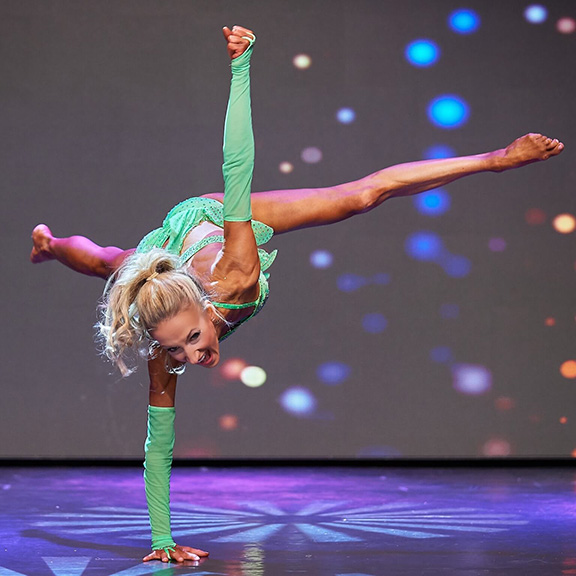
Years later, a doctor said she should probably start working out. Her answer was “probably not.” She went to a gym anyway, where someone asked if she wanted to enter a fitness competition. Butulis told him he had the wrong person. A few weeks later, she said yes, got on stage, placed last, and loved it.
Finishing last only made her more curious. “If I want to be a better mover, I better study something that involves becoming a better mover in athletic ways,” she says. “So that’s how I got into NSCA and all of that.”
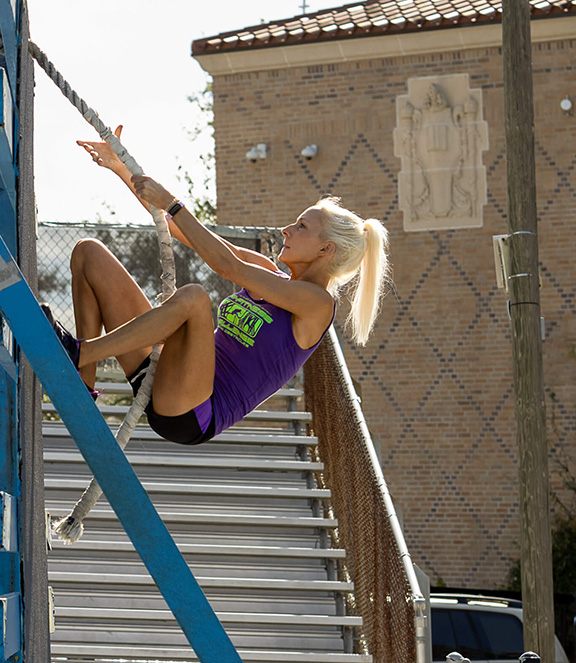
Later, when her coach suggested a seven-round, all-around competition, Butulis explained she didn’t even know how to jump rope. She flew from Minneapolis to Tampa to meet the head coach, who kept saying, “Yes, you can.” Within an hour, she was jumping rope and doing box jumps.
“He kept saying, ‘You are an athlete,’” Butulis recalls. “And I was like, ‘I don’t know who you’re talking to right now. Is there somebody behind me?’” She later became a three-time world fitness champion.
Big Ears, Big Eyes
After hurting her ankle in dance class at 14, Butulis struggled to find a physical therapist who understood what she was trying to do with her feet. Her guidance counselor’s advice stayed with her: “You can be part of the solution, or you can be part of the problem.” Soon, Butulis began the 400 shadow hours required for an accelerated physical therapy program.
Years into her physical therapy career, the cueing of strength and conditioning coaches in the same facility caught her attention. She brought physical therapy patients into the gym and watched the coaches closely. “I felt in awe of what they did,” she says. “I would hear their cues and say, ‘Why are they doing it that way?’”
Their cues were detailed, precise, and minimal. Then she saw a coach draw a picture of what good coaching looked like: giant ears and giant eyes. “If you take it in, you know the right thing to say to the athlete at the right time,” Butulis says. “That creates the difference of what happens next.”
Butulis wanted to be that kind of coach. When she asked where to start, the coaches pointed her to the CSCS® as “step one,” a way to get a foot in the door, have those conversations, and keep learning at conferences. Earning the credential gave her a formal way to study technique and program design and connect rehabilitation with athletic movement. She still thinks about those giant ears and eyes when deciding what to say and when to stop.
Curious Conversations
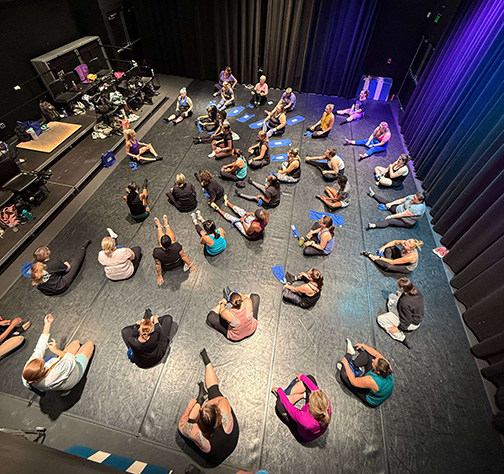
Today, Butulis works as a physical therapist at Sarasota Memorial Healthcare System and leads Pilates at a fitness facility. She also teaches yoga at a sports development boarding academy, where she has served as a strength and conditioning coach. Her work moves between older adults, academy athletes, dancers, and training clients.
Older adults often bring years of medical history. Younger athletes may have fewer medical concerns, but Butulis says they haven’t always spent enough time “living in their own human” to know what their bodies are telling them. Dancers bring another layer: they may know when a neck position is off by a millimeter, but they still picture Arnold Schwarzenegger when they think of strength and conditioning.
When physical therapy and strength and conditioning overlap, Butulis says there’s a fear of professional encroachment, but her approach is collaborative. “We complement each other. We don’t take over each other’s roles.” In practice, she holds judgment and asks the goal of a cue or exercise. “If we keep having those curious conversations and realizing the value that comes next, we can understand and appreciate the depth of education that goes into each profession.”
The recent APTA-NSCA Joint Principles Statement reinforces that idea, recognizing the complementary roles of physical therapists and strength and conditioning professionals across rehabilitation, reconditioning, and performance.
Butulis’ full credential list is extensive, spanning clinical exercise, manual therapy, movement assessment, Pilates, yoga, dance-specific training, behavior change, and nutrition coaching. But she says the letters were never the goal. “I never set out to accumulate degrees. I never set out to accumulate certifications,” she says. “That was never a goal, but I just listened to the people in front of me, and I realized what they were asking of me.”
She has also found a place to contribute through the NSCA Special Populations Special Interest Group, where she serves as an Executive Council Member.
“If I have something or some knowledge or some idea that is going to help somebody succeed more at what they’re trying to do, why would I not share it?”
From the Field: Meredith’s Perspective
Q: How do you help people build body intuition?
A: A lot of it is building self-efficacy and belief. I show them where we’re at today and try to take it one little tiny mini step forward. With my showboaters, I try to show them something they can’t do instead of what they can do. Then they realize, “Oh, maybe I should try that.”
Q: How do you make limited training time count?
A: I try to think about what we can fit into daily activities and just do it a little different. I’ll ask someone to talk me through their day, then ask, “How do you do that?” If they’re sitting down into a chair, that’s a hip hinge. If they don’t want to exercise, we can still talk about standing up and sitting down 10 times in a row. I try to take what we already do and polish it.
Q: What advice would you give developing professionals looking for mentorship?
A: For me, it’s been very informal. I found most of my most idolized mentors by accident. My favorite mentee did the same thing to me. She became a “sticky shadow.” She kept coming back, asked good questions, and asked at the right time.
You just read an article from the NSCA’s Member Spotlight series. Your path might be exactly what another strength and conditioning professional needs to see. Share your story with marketing@nsca.com.

- Privacy Policy
- Your Privacy Choices

- Terms of Use
- Retraction and Correction Policy
- © 2026 National Strength and Conditioning Association