

Sample Training Program for a Ranger Unit
by William J. Kraemer, PhD, CSCS,*D, FNSCA and Brian K. Schilling, PhD, CSCS, FNSCA
Other
May 2026
The following is an exclusive excerpt from the NSCA’s Essentials of Tactical Strength and Conditioning, Second Edition, published by Human Kinetics. All text and images provided by Human Kinetics.
No one-size-fits-all strength and conditioning program exists that will be appropriate for all service members. As mentioned, optimal programming must address the physical requirements of the military personnel’s occupational specialty and the unit’s mission, and it must factor in constraints such as competing military training requirements that must be prioritized in a given training cycle; military personnel’s availability, readiness, and motivation to train; and special considerations for the individual’s goals, strengths, and weaknesses. Personal factors, such as home life or disrupted sleep schedules, will also affect training outcomes. To implement a program that is not only effective but also is one that military personnel can adhere to, the TSAC Facilitator should maintain flexibility in the program design, such as using the flexible nonlinear approach or short training blocks of three to four weeks with adequate recovery and reduced loading periods. Chapter 9 provides more information on periodization and sample programs that can be used as a starting point for developing a training program for a military population, and other publications also provide examples (35, 37, 38).
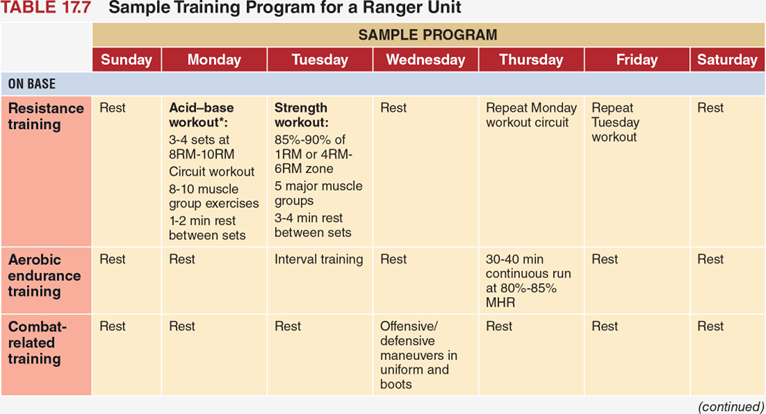
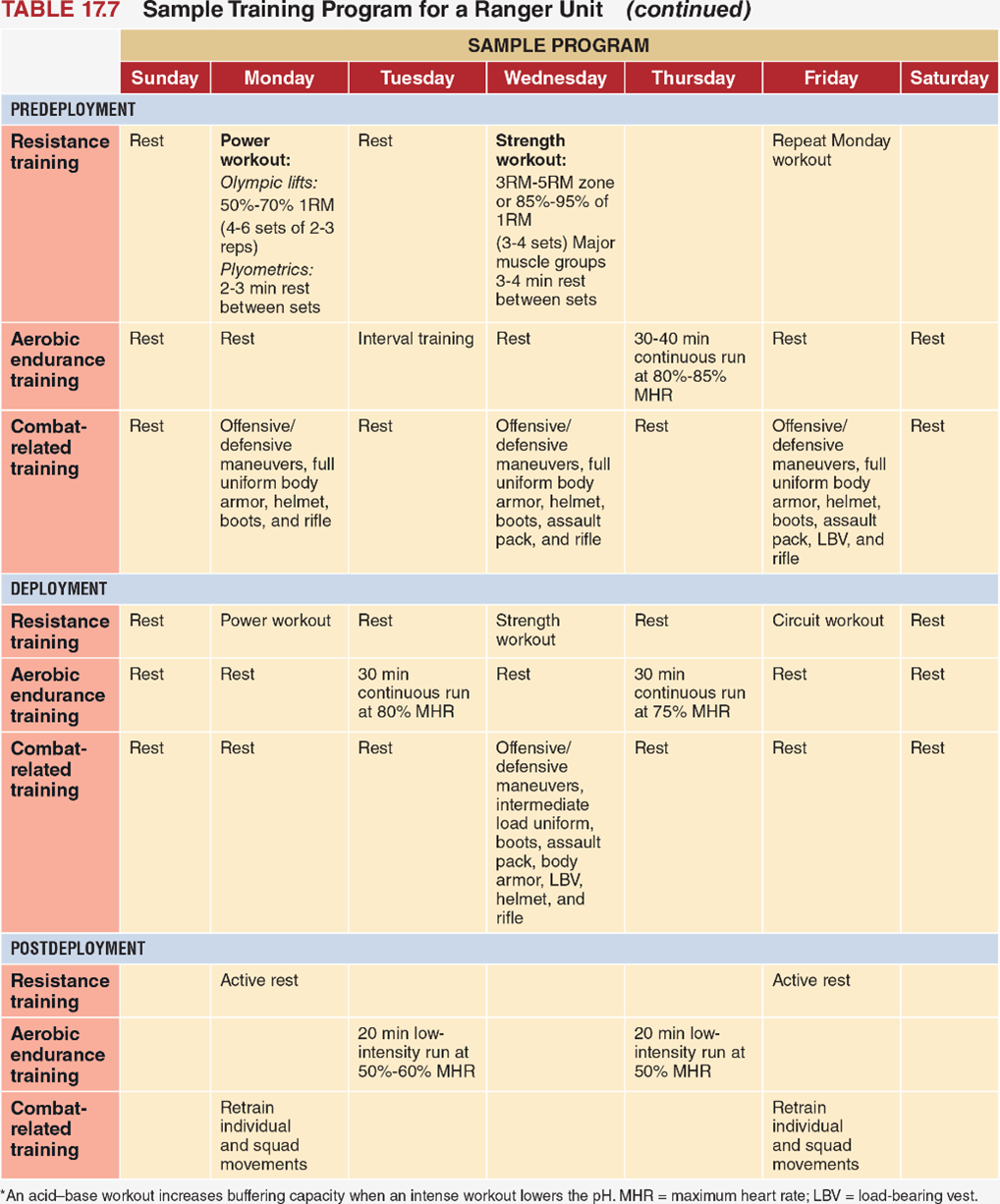
A sample training program for a Ranger unit is provided in table 17.7. This program incorporates a resistance training schedule using a flexible nonlinear program. The TSAC Facilitator can then change the programs related to circuit training, strength, power, aerobic endurance, or combat-related training. The key is to make the program work with the operational demands and time constraints of the occupational specialty and the unit in order to train the elements needed for combat readiness, including anaerobic endurance, cardiorespiratory function, and strength and power for demanding tasks, as discussed in detail elsewhere (23, 30). The program shows what might be done on base and then during predeployment, deployment, and postdeployment. Using knowledge of program design from this book and others will allow the TSAC Facilitator to develop programs in response to individual and unit demands during these three periods of military service.

- Privacy Policy
- Your Privacy Choices

- Terms of Use
- Retraction and Correction Policy
- © 2026 National Strength and Conditioning Association