

A Framework for Annual Planning and Programming for Division II Women’s Cross Country and Track and Field Distance Runners
by Mike Waller, PhD, USAW-2, CSCS,*D, NSCA-CPT,*D, FNSCA, and Ian Bonder, MS, CSCS,*D, RSCC
NSCA Coach
March 2026
Vol 13, Issue 1
This article examines strength and conditioning strategies for collegiate cross country and track distance runners, including year round planning to build performance for outdoor competition.
INTRODUCTION
The integration of a strength and conditioning annual plan and program for cross country, distance runners, and track and field athletes may help with improving running economy, course navigation performance, aerobic power, and injury prevention (1,2,4,5,21,26,28,30,33). These athletes often compete in both cross country and the track and field distance events, thus creating a unique situation of limited time in between competitive seasons, as the collegiate cross country season runs August to October, followed by the outdoor track and field season running March to May. The indoor track and field season begins in December and lasts through the beginning of the outdoor season in March. Women cross country athletes must run a six-kilometer outdoor course that has irregular terrain features, incline/decline hills of varying angles, turns, small barriers, and opponents to pass. If these same athletes are competing in the distance events for track and field, they may have to run distances ranging from 800 m, 1,500 m, 3 km steeple, 5 km, 10 km, and the medley relay during the indoor and outdoor season. This article presents the strength and conditioning planning and programming for cross country and track and field distance runners that compete in both seasons, and utilize the indoor track and field season as preparation for the outdoor season.
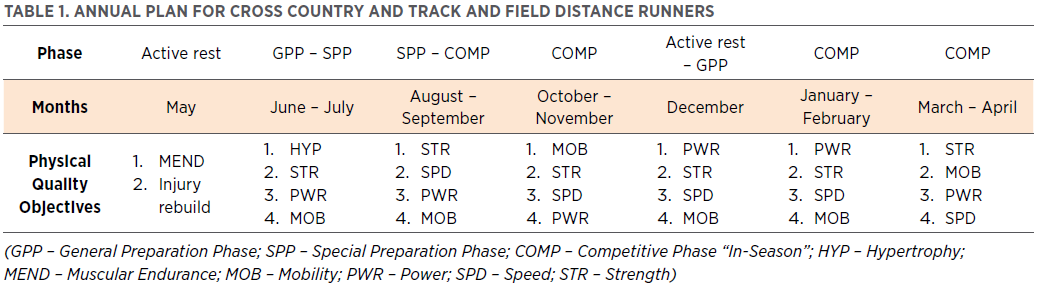
A challenge working in adequate general preparation and active recovery phases during the academic year is that the seasons for these sports limit the time to build/rebuild these athletes for competition. There is a need to incorporate training that focuses on injury prevention and rebuilding from previous injuries that frequently occur in cross country and track and field distance events. Common injuries and sites among these sports are shin splints, ankle sprains, hamstring strains, medial tibial stress syndrome, iliotibial band (ITB) syndrome, and plantar fascia strain that may be minimized by improving muscular strength and reducing muscle imbalances and asymmetries (11,18,24,37,38). The needs analysis for the top three common injuries establishes a starting point for the strength and conditioning coach that guides programming, which can be further adjusted based on the team’s and individual athlete’s injury screening. Table 1 provides a sample annual plan for cross country and track and field distance athletes. The needs of cross country and track and field distance events focus on physical quality objectives of hypertrophy, muscular endurance, strength, power, mobility, and speed. The objective of hypertrophy is to increase muscle mass during the off-season period and can translate to improved running performance while mitigating injury risk (31). Furthermore, greater muscle mass may also increase the amount of muscle glycogen the athlete could store, thus improving running performance with sustained energy (20). Sport coaches and strength and conditioning coaches may choose to monitor changes in muscle mass by examining body fat percentage with female athletes ranging between 15 – 28% using skin fold measurements or handheld bioelectric impedance analysis devices, if more precise equipment is not available to monitor muscle cross sectional area (17,24,31). By increasing muscular endurance, strength, and power, these endurance running athletes could see improvements in running economy, stride frequency, and their ability to apply force into the ground (1,2,4,5,21,23,36). Further improvements to the runners’ speed can be achieved not only through sprint training but also by including exercises that require high contraction velocity such as repeat horizontal jumps and rapid low box toe touches (14). Programs that include exercises to improve athletes’ muscular ability to produce speed via faster contraction-relaxation may improve step rate that can translate to reduced ground reaction forces (27). The program should also include mobility exercises (e.g., instep lunge, overhead squat), which may be emphasized during the competitive phases to assist in physical restoration and allow for improved leg motions. Other areas that should be addressed in cross country and track and field distance runners’ training are the calf muscles, ITB, and quadriceps and hip flexor muscle groups, which will be discussed in the testing, annual plan, and programming sections. This article presents testing options that have been used to assess these female endurance athletes, planning of training program phases, and programming of exercises, methods, and volume.
TESTING
The volume of mobility and specific exercises may be guided by the results from performing the overhead squat for hip and trunk muscle flexibility, the Thomas Test for hip flexor muscle group flexibility and hip joint range of motion (ROM), and hamstring muscle group flexibility tested by single-leg raise goniometer testing. The overhead squat follows the test protocol of the “deep squat” from the Functional Movement Screen™ (FMS) using the 0 – 3 scoring system that may identify areas in need of additional mobility exercises (3,15,29). The Thomas Test can be used to help direct individualized hip flexor mobility and flexibility planning, while the antagonist test (i.e., the single-leg raise) allows for an objective measurement of hamstring flexibility that may limit athlete leg movement. As a team, symmetrical ROM for the left and right legs with values ranging between 70° – 90° may be used as a guide for determining if additional exercises for mobility and hamstring flexibility are needed.
The muscular performance tests are used for the planning stages of program and can involve the squat jump, countermovement jump, and one-step approach for assessing lower body power development from varying neuromuscular performances. Three unique jump variations allow for assessment of the athletes’ ability to concentrically develop power through the squat jump, time to develop force with greater use of the stretch-shortening cycle (SSC) in the countermovement jump, and the ability to use the SSC effectively with a pre-stretch in the one-step approach (6). If the standard deviations of these testing means overlap, this suggests that the athletes’ strength and conditioning sessions should pivot to include exercises to increase power while emphasizing SSC activity. Lastly, vertical hops (e.g., “single-leg jump”) may be performed to assess if any athletes have asymmetric power production between their legs. A 10% discrepancy between the vertical hop heights can be used to determine if an athlete requires additional attention to unilateral strength and power training.
Collectively, the results of these bilateral and unilateral power tests can guide the planning and progression of exercises such as sumo deadlifts for bilateral strength to step-ups for unilateral strength. The development and maintenance of power is challenged by the amount of repetitive impact the runners experience during their training, so close attention should be paid to any athlete’s subjective statements of pain in the lower extremity. To ensure athlete safety and well-being, the strength and conditioning coach has a responsibility to reduce training volume and adjust exercises so athletes can have adequate recovery time.
Lastly, aerobic power (i.e., maximal oxygen consumption [VO₂max]) can be assessed using a modified Bruce Protocol, with the results reported to the sport coach to guide the sport training (16). In general, expectations for athlete VO₂max values should be > 50 ± 3.2 ml/kg/min, which is in line with other reported VO₂max levels of > 800-m runners (32,35). Although the aerobic power test can provide valuable information, it may not be applicable to the strength and conditioning planning as this should be the focus of the sports coach training. Overall, the results of the preceding tests can be assessed and provided to the sports coach with strength and conditioning coach commentary/feedback on areas that require attention and consequently guide how the strength and conditioning annual plan and program will progress throughout the seasons.
ANNUAL PLAN
Annual planning for these sports is presented in Table 1, which starts with the summer active rest phase (ARP) beginning mid-May with the primary goal of improving muscular endurance and injury rehabilitation for individual needs. The duration of the ARP is typically only a few weeks with some of the components carried over to the general preparation phase (GPP), that lasts from June to July. The primary objectives of the GPP are in the following priority order: hypertrophy, strength, power, and mobility. There could potentially be two separate GPPs: one for first year or transfer athletes and the other for those athletes returning to the team. The first year or transfer athletes can follow a wave method for the training volume and intensity with repetition and intensity range progression of 12 – 15 repetition maximum (RM) with sets fluctuating between 3 – 4 sets for day one and a 5 – 12 RM for three sets ending with a de-load week at the end of the GPP. As is often typical in collegiate athletics, the strength and conditioning coach will have no prior knowledge of the transfer or first time athletes’ previous training practices and experience. Additionally, for some athletes, college athletics or their new school may be their first time participating in a structured training program.
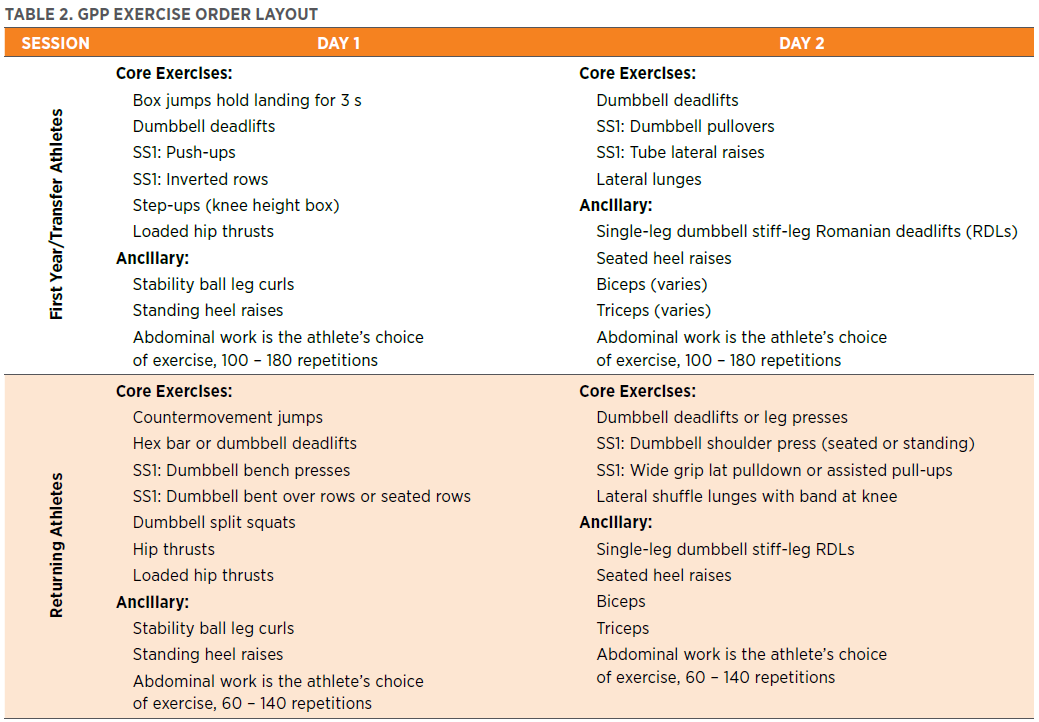
To concurrently mitigate injury risk and integrate first year and transfer athletes to a specific strength and conditioning coach’s training philosophy and program, it would be prudent to minimize liability and coaching malpractice as much as possible by starting these athletes in a general, baseline training program. The first year and transfer athletes’ programming can then be customized accordingly based on the results of the preceding tests and their individual progress and improvements to their prescribed training. Table 2 demonstrates an example exercise order and selections during the GPP for both athlete categories (returning and first year or transfer).
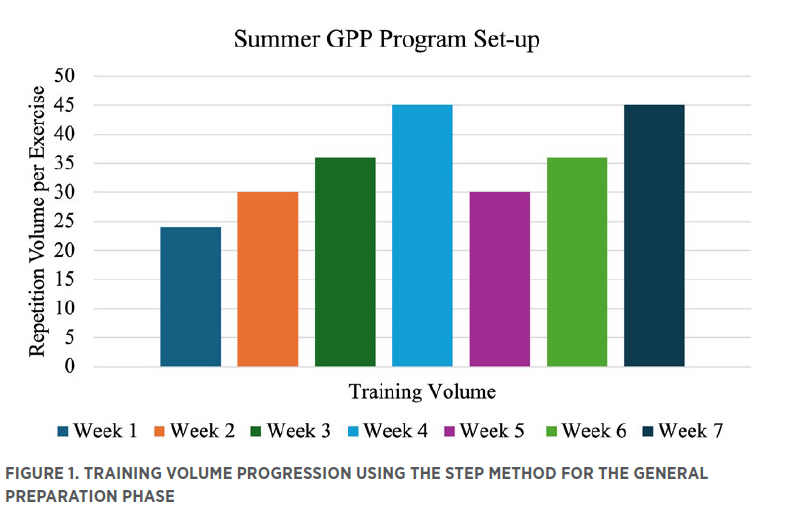
During all phases, training adjustments will need to be made once the program is implemented to adjust for time efficiency, injuries, coaching requests, and team preparation for competitive events. The strength and conditioning weekly session volume can follow a step progression (seen in Figure 1), while other phases may utilize wave training and de-load weeks prior to competitions. Generally, athletes begin the academic year in August with a special preparation phase (SPP) that will quickly transition to the cross country competition phase, lasting to the end of October or beginning of November. The primary objectives of the SPP and competition phases should be in the following priority order: strength, speed, power, and mobility. The preceding phases should then be focused on multi-joint movements such as the sumo-style deadlift, clean jump shrug, box jumps with step down, backward medicine ball throw, fast toe touches on box, and suspension trainer push-ups and rows. The ancillary movements are for the posterior chain, while unilateral movements may mitigate the injury risk from the running mileage accumulated during the season’s training. Training volume can progress from 2 – 4 sets with repetitions ranging from 3 – 5 in power and speed exercises and 3 – 5 for the strength exercises, while intensity may appropriately be adjusted based on the progressive overload principle. Following the end of the competition phase, training priorities shift to restoration with mobility becoming the focal point. Other aspects of training can be decreased for 2 – 3 weeks, with a gradual increase in attention to power, strength, and speed that carries the athletes’ training over winter break until return to campus for the track and field seasons.
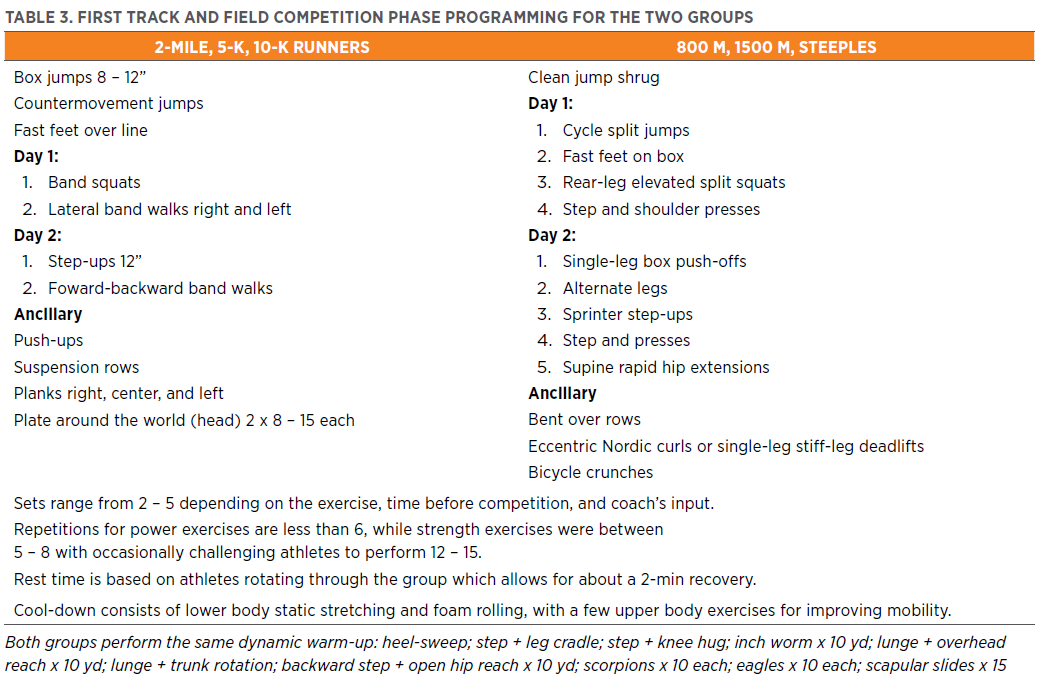
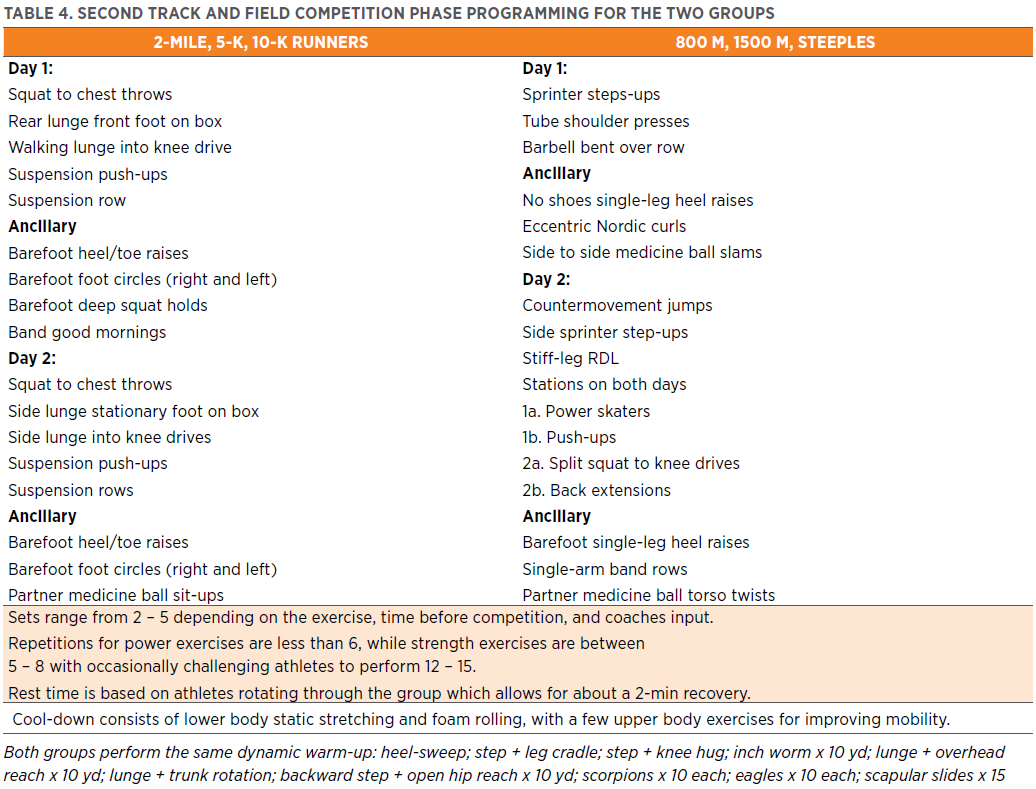
The winter session serves as a GPP phase, as the time to the first indoor competition may only be a few weeks after the athletes return to campus. Oftentimes, the team goal of the indoor season is to prepare for the outdoor season, which allows for the strength and conditioning training to emphasize power development that is divided into two groups. Table 3 presents an example of programming during a competition phase while Table 4 presents example programming for the outdoor track and field season competition 2 phase. The indoor track and field season should then focus on maintaining strength throughout the season, while mobility can serve a prominent role in assisting with physical restoration. A step method progression can be used for intensity and/or volume during these phases, depending on the exercises and timing of competitions. The set and repetition ranges are provided in the table as examples/starting points and may be modified based on the athletes’ daily and weekly fatigue and response to training. During the competition phases, communication with the sport coach and athlete will be critical for precisely adjusting training volume and intensity.
ADJUSTMENTS TO PROGRAMMING
As the competition seasons progress and transitions from one sport to the next, adjustments to programming and training should be made in accordance with the coach’s feedback, athletes’ requests/comments, and injuries sustained. Examples of team feedback during a season may include complaints of tight calves or knee discomfort, which provides justification to put additional time into foam rolling and stretching of the ITB, calf, and hamstring muscles to assist in restoration. The time spent on addressing muscular tightness comments may help reduce some of the discomfort experienced by the athletes, potentially being included earlier in the program. The occurrence of overuse injuries, such as foot stress fractures, requires individualized programs to work around injured areas while adding in the athlete’s return to play (RTP) program. Specific RTP programs are beyond the scope of this article and the strength and conditioning coach is directed to review literature and consult sports medicine staff to develop an effective program (10). Additionally, changes to team travel may provide challenges that necessitate adjustments to exercise selection and volume within the program to assist in competition preparation.
ALTERNATE PROGRAMMING CONSIDERATIONS
The stressors cross country and track and field distance runners experience during their preparatory and competitive phases may also necessitate modified programming structures to provide adequate restoration. One option that may be of benefit is the application of microdosed programming that redistributes training volume across more frequent, shorter duration training sessions, potentially allowing for improved recovery and greater intent during training (13,34). While this programming method increases training frequency, the shorter duration training sessions allow for more time to be spent on recovery (e.g., naps) and recuperative modalities (e.g., ice baths). Previous literature has shown this programming method to be beneficial when used with tactical populations (7,25), female collegiate basketball players (8), and field hockey athletes (12). Furthermore, when compared with a traditional programming model, microdosed programming is reported to produce similar, if not superior, training adaptations in those populations studied. For a more in-depth discussion on the training methods to incorporate with microdosed programming and a list of the physiological qualities that may benefit, readers are directed to Bonder et al. (9). An example microdosed training template that can be adjusted to meet the demands of cross country and track and field distance runners using the preceding content can be found in Bonder and Shim (8).
The physical qualities that cross country and track and field distance runners must maintain across two competitive seasons in an annual plan may find block periodization a particularly useful planning principle for strategizing programming. Block periodization sequences specialized meso-cycles with a focus on minimal physical qualities and motor control abilities that can transition from cross country to track and field with multiple shorter phases (19). This planning concept relies on the theory of residual super-compensatory training effects whereby training adaptations are sustained for a specific time frame so separate physical qualities may be focused on with programming. For example, aerobic power has a residual training effect of 30 ± 5 days while speed has a residual training effect of 5 ± 3 days (19). A full list of residual training effects by physical quality can be found in Issurin (19). Thus, speed should be programmed into training once per week, while aerobic power does not need to be the focus of training as often, especially because the athletes will train this quality sufficiently while practicing their given sport. By strategically training for one or two similar physical qualities at a time, the possibility of a training interference effect and the use of similar repetitive movements may be minimized, while systematically improving performance and enhancing physical recovery. As cross country and track and field distance runners typically complete a high weekly volume of aerobic training, block periodization within a microdosed programming model may be the ideal choice to incorporate resistance and plyometric training modalities for this population (20). Dozens of set and repetition scheme possibilities to adapt and successfully incorporate block periodization can be found in Jovanović (22).
PRACTICAL APPLICATIONS
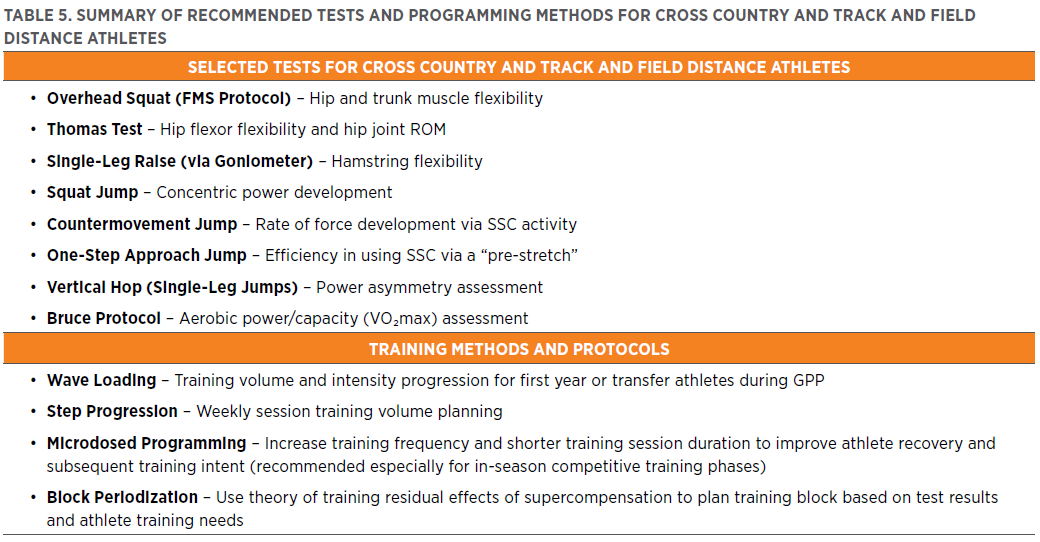
There are several challenges cross country and track and field distance runners face when attempting to perform optimally, including competing in two consecutive seasons with minimal downtime between each. The need to maintain or improve several competing physical qualities further compounds the challenges faced by strength and conditioning coaches working with this group. Additionally, the concurrent training of aerobic performance and power and strength training requires the appropriate application during training and planning during programming, as the goals are sustained cyclic performance instead of short duration (< 10 s) skill execution. Planning athletes’ training over the two seasons, programming for sport specificity, and adjusting as seasons progress will ultimately allow for overcoming many common obstacles encountered when training this population. Table 5 provides a summary of the testing and programming methods used as part of the example annual plan provided in Table 1. These suggestions may be incorporated and modified to fit the unique demands of different cross country and track and field distance teams, coaching philosophies, sport coach requests, athlete needs, and training environments that a strength and conditioning coach could encounter when training this population.
This article originally appeared in NSCA Coach, a quarterly publication for NSCA Members that provides valuable takeaways for every level of strength and conditioning coach. You can find scientifically based articles specific to a wide variety of your athletes’ needs with Nutrition, Programming, and Youth columns. Read more articles from NSCA Coach »
REFERENCES
- Barrie, B. Concurrent resistance training enhances performance in competitive distance runners: A review and programming implementation. Strength and Conditioning Journal 42(1): 97-106, 2020.
- Bazyler, CD, Abbott, HA, Bellon, CR, Taber, CB, and Stone, MH. Strength training for endurance athletes: Theory to practice. Strength and Conditioning Journal 37(2): 1-12, 2015.
- Beardsley, C, and Contreras, B. The Functional Movement Screen: A review. Strength and Conditioning Journal 36(5): 72-80, 2014.
- Beattie, K, Carson, BP, Lyons, M, Rossiter, A, and Kenny, IC. The effect of strength training on performance indicators in distance runners. Journal of Strength and Conditioning Research 31(1): 9-23, 2017.
- Blagrove, RC, Brown, N, Howatson, G, and Hayes, PR. Strength and conditioning habits of competitive distance runners. Journal of Strength and Conditioning Research 34(5): 1392-1399, 2020.
- Bobbert, MF, Gerritsen, KGM, Litjens, MCA, and Van Soest, AJ. Why is countermovement jump height greater than squat jump height? Medicine and Science in Sports and Exercise 28(11): 1402-1412, 1996.
- Bonder, I, Shim, A, Lockie, RG, and Ruppert, T. A preliminary investigation: Evaluating the effectiveness of an occupational specific training program to improve lower body strength and speed for law enforcement officers. International Journal of Environmental Research and Public Health18(14): 7685, 2021.
- Bonder, IJ, and Shim, AL. In-Season training model for National Association of Intercollegiate Athletics female basketball players using “Microdosed” programming. Strength and Conditioning Journal 45(4): 395-410, 2023.
- Bonder, IJ, Waller, M, Shim, AL, and Tangeman, MA. Time-saving versus time-efficient training terminology, methods, and prescription. Strength and Conditioning Journal 46(3): 308-319, 2024.
- Caterisano, A, Decker, D, Snyder, B, Feigenbaum, M, Glass, R, House, P, et al. CSCCa and NSCA joint consensus guidelines for transition periods: Safe return to training following inactivity. Strength and Conditioning Journal 41(3): 1-23, 2019.
- Chandron, A, Morris, SN, Boltz, AJ, Robinson, HJ, and Collins, CL. Epidemiology of injuries in National Collegiate Athletic Association women’s cross-country: 2014–2015 through 2018–2019. Journal of Athletic Training 7: 622-628, 2021.
- Cuadrado-Peñafiel, V, Castaño-Zambudio, A, Martínez-Aranda, LM, González-Hernández, JM, Martín-Acero, R, and Jiménez-Reyes, P. Microdosing sprint distribution as an alternative to achieve better sprint performance in field hockey players. Sensors (Basel, Switzerland) 23(2): 650, 2023.
- Cuthbert, M, Haff, GG, Arent, SM, Ripley, N, McMahon, JJ, Evans, M, et al. Effects of variations in resistance training frequency on strength development in well-trained populations and implications for in-season athlete training: A systematic review and meta-analysis. Sports Medicine (Auckland, N.Z.) 51(9): 1967-1982, 2021.
- Ebben, WP. Maximum power training and plyometrics for cross-country running. Strength and Conditioning Journal 23(5): 47-50, 2001.
- Frost, DM, Beach, TAC, Callaghan, JP, and McGill, SM. FMS scores change with performers’ knowledge of the grading criteria—Are general whole-body movement screens capturing “dysfunction”? Journal of Strength and Conditioning Research 29(11): 3037-3044, 2015.
- Gibson, AL, Wagner, DR, and Heyward, VH. Advanced Fitness Assessment and Exercise Prescription (8th ed). Champaign, IL: Human Kinetics; 2018.
- Giffin, KL, Knight, KB, Bass, MA, and Valliant, MW. Predisposing risk factors and stress fractures in collegiate cross-country runners. Journal of Strength and Conditioning Research 35(1): 227-232, 2021.
- Hopkins, C, Kanny, S, and Headley, C. The problem of recurrent injuries in collegiate track and field. International Journal of Sports Physical Therapy 17(4): 643-647, 2022.
- Issurin, V. Block periodization versus traditional training theory: A review. The Journal of Sports Medicine and Physical Fitness 48(1): 65-75, 2008.
- Issurin, VB. Biological background of block periodized endurance training: A review. Sports Medicine (Auckland, N.Z.) 49(1): 31-39, 2019.
- Jones, P, and Bampouras, TM. Resistance training for distance running: A brief update. Strength and Conditioning Journal 29(1): 28-35, 2007.
- Jovanović, M. Strength Training Manual: The Agile Periodization Approach. Theory – Volume One and Two. Mladen Jovanović; 2020.
- Karp, JR. Strength training for distance running: A scientific perspective. Strength and Conditioning Journal 32(3): 83-86, 2010.
- Kelsey, JL, Bachrach, LK, Procter-Gray, E, Nieves, J, Greendale, GA, Sowers, M, et al. Risk factors for stress fracture among young female cross-country runners. Medicine and Science in Sports and Exercise 39(9): 1457-1463, 2007.
- Kilen, A, Hjelvang, LB, Dall, N, Kruse, NL, and Nordsborg, NB. Adaptations to short, frequent sessions of endurance and strength training are similar to longer, less frequent exercise sessions when the total volume is the same. Journal of Strength and Conditioning Research 29(Suppl 11): S46-S51, 2015.
- Li, F, Newton, RU, Shi, Y, Sutton, D, and Ding, H. Correlation of eccentric strength, reactive strength, and leg stiffness with running economy in well-trained distance runners. Journal of Strength and Conditioning Research 35(6): 1491-1499, 2021.
- Madden, TS, and Hawkins, DA. Increasing step rate reduces peak and cumulative insole force in collegiate runners. Medicine and Science in Sports and Exercise 56(5): 982-989, 2024.
- Marcello, RT, Greer, BK, and Greer, AE. Acute effects of plyometric and resistance training on running economy in trained runners. Journal of Strength and Conditioning Research 31(9): 2432-2437, 2017.
- Monaco, J-T, and Schoenfeld, BJ. A review of the current literature on the utility of the Functional Movement Screen as a screening tool to identify athletes’ risk for injury. Strength and Conditioning Journal 41(5): 2019
- Ramos-Campo, DJ, Andreu Caravaca, L, Clemente-Súarez, VJ, and Rubio-Arias, JA. The effect of strength training on endurance performance determinants in middle- and long-distance endurance athletes: An umbrella review of systematic reviews and meta-analysis. Journal of Strength and Conditioning Research 39(4): 492-506, 2025.
- Roelofs, EJ, Smith-Ryan, AE, Melvin, MN, Wingfield, HL, Trexler, ET, and Walker, N. Muscle size, quality, and body composition: Characteristics of Division I cross-country runners. Journal of Strength and Conditioning Research 29(2): 290-296, 2015.
- Ruiz-Alias, SA, Marcos-Blanco, A, Fernandez-Navarrete, I, Garcıa-Pinillos, F, and Perez-Castilla, A. Exploring the relationship between diverse strength qualities and endurance running performance across different intensities in recreational men and women runners. Journal of Strength and Conditioning Research 39(1): 24-32, 2025.
- Symons, R. Weight training conditioning for cross-country runners. Strength and Conditioning Journal 11(5): 57-59, 1989.
- Tan, B. Manipulating resistance training program variablesto optimize maximum strength in men. Journal of Strength and Conditioning Research 13(3): 289-304, 1999.
- Thron, M, Woll, A, Doller, L, Quittmann, OJ, Härtel, S, Ruf, L, and Altmann, S. Physiological and locomotor profiling enables to differentiate between sprinters, 400-m runners, and middle-distance runners. Journal of Strength and Conditioning Research 38(8): 1419-1427, 2024.
- Turner, AN. Training the aerobic capacity of distance runners: A break from tradition. Strength and Conditioning Journal 33(2): 39-42, 2011.
- Vannatta, CN, Blackman, T, and Kernozek, TW. Kinematic and muscle force asymmetry in healthy runners: How do different methods measure up? Gait and Posture103: 159-165, 2023.
- Venable, EN, Seynaeve, LA, Beale, ST, Gamez Jr, A, Domingo, A, Rosenthal, MD, and Rauh, MJ. Relationships between running biomechanics, hip muscle strength, and running-related injury in female collegiate cross-country runners. International Journal of Sports Physical Therapy 17(6): 1053-1062, 2022.
Audience:
Coaches
Coaches
Topics:
Exercise Science Exercise Technique Program design Organization and Administration Testing and Evaluation Basic Pathophysiology and Science of Health Status or Condition and Disorder or Disease Professional Development
Exercise Science Exercise Technique Program design Organization and Administration Testing and Evaluation Basic Pathophysiology and Science of Health Status or Condition and Disorder or Disease Professional Development
Keywords:
Return To Play (RTP) NCAA Athletics Muscular Endurance Exercise Programs Aerobic Power Weight Training Running College Track and Field Women Sports
Return To Play (RTP) NCAA Athletics Muscular Endurance Exercise Programs Aerobic Power Weight Training Running College Track and Field Women Sports

- Privacy Policy
- Your Privacy Choices

- Terms of Use
- Retraction and Correction Policy
- © 2026 National Strength and Conditioning Association